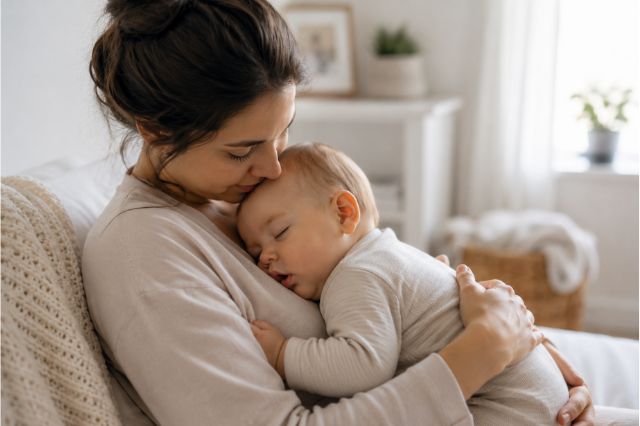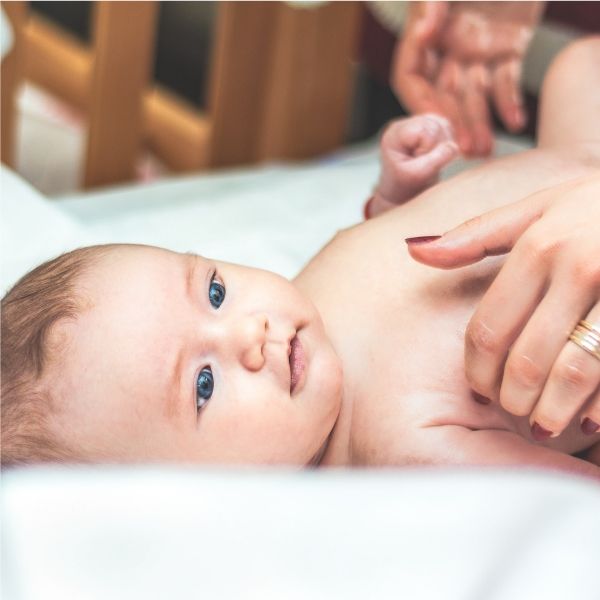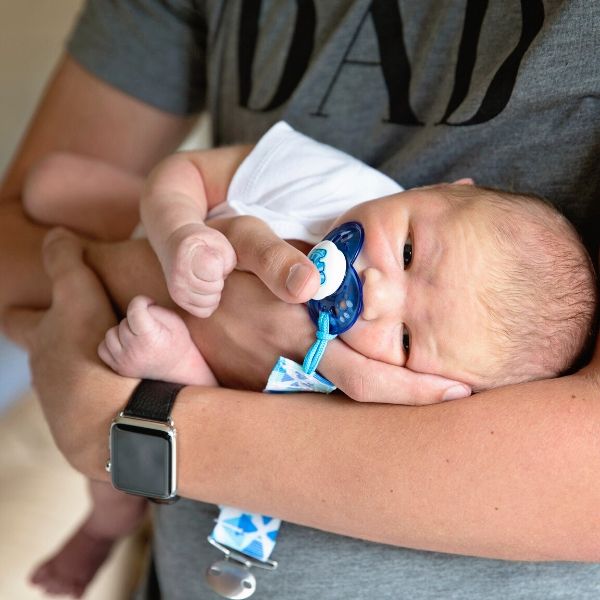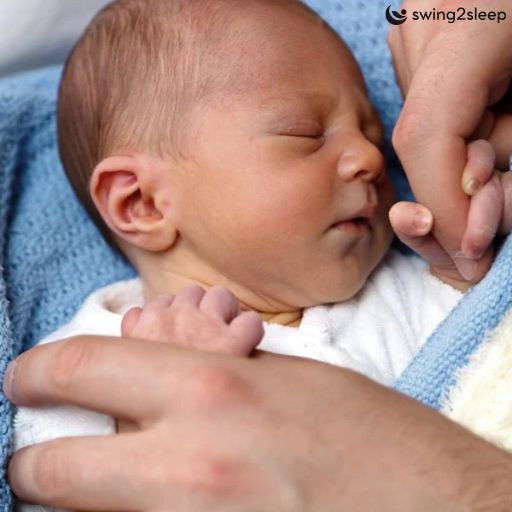
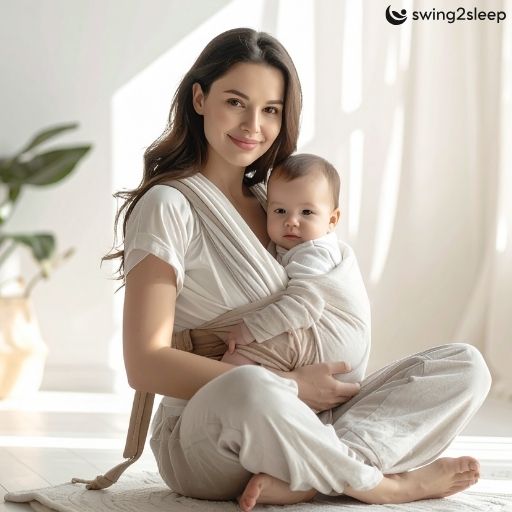


Some parents are unsure whether they are carrying their baby too much or too little. In fact, you can hardly carry a baby too much, whether it's in your arms, in a wrap, or in a carrier.
Your baby will benefit from it because you are fulfilling an important basic need of the child. The reason for this lies far back in early human history.
 Why do "Traglinge" (carried young) need physical proximity?
Even in the womb, the baby was rocked almost permanently and was constantly in the closest contact with the mother. Therefore, it remains an important need even after birth.
This has consequences: Babies who are carried and allowed to enjoy plenty of skin contact with mom or dad sleep better, develop according to their age, and are often calmer and more content overall.
But there is another explanation. Let's take a short trip into the animal kingdom for this. Mammals and birds were previously generally divided into two groups: altricial (nest-bound) and precocial (nest-fleeing).
Upon closer inspection, it quickly becomes clear that human babies don't seem to fit into either group. This is because, from a biological perspective, our species belongs to another category that was only introduced in the 1970s: "Traglinge" (carried young).
Human babies are carried young
We share this category with other mammals such as monkeys, koalas, and kangaroos. Carried young spend the first part of their lives snuggled close to the mother (or father). Protected in this way, they begin to perceive the environment while their bodily functions and abilities slowly develop.
The more this happens, the more often the carried young will leave the parent's body. Strictly speaking, carried young are born too early. They are not yet able to walk on their own at birth, and many mental functions or physical abilities are not yet developed.
Therefore, they spend the first period either in a pouch or at least snuggled close to the mother. In infancy, the child is equipped with the grasping reflex for this purpose, for example. If you lift the baby, another reflex becomes noticeable, in which the baby automatically assumes the so-called spread-squat position, an optimal carrying posture.

What are the benefits of carrying in a wrap or a baby carrier?
Especially if you have a colicky baby, carrying in a wrap or a baby carrier brings great relief to you and your baby. By being carried, your baby is immediately transported back into its familiar world.
It is snuggled close to mom or dad and is held and rocked while feeling your body heat and hearing your soothing heartbeat. Colicky babies in particular should also be shielded from too many sensory impressions. This way, it feels completely at home again. In addition, an important subliminal communication takes place between you and your baby.
The gentle rocking back and forth stimulates the vestibular system with a variety of positive effects for early childhood development. It supports spatial orientation, cognitive abilities, and motor skills. In short, rocking has a positive effect on the entire infantile physiology and mental development.
Babies who are carried a lot also show not only faster growth but also more stable breathing and more stable heart rates. They cry less and sleep better.
Babies who hear an adult's breath are, in a sense, reminded to breathe themselves. This even works when the baby is placed next to a teddy bear that simulates a breathing cycle, although no teddy could ever replace mom or dad.
However, carrying in a wrap offers numerous other advantages, for example:
- Promotion of a close bond
- Soothing for colic or anxiety
- hands-free
- almost unlimited freedom of movement
- carried children cry significantly less
- strengthening of parental sensitivity
- carrying in the spread-squat position is proven to prevent hip dysplasia
- strengthening of basic trust
- direct interaction between the child and you through eye or hand contact
- the child can control phases of attention and rest themselves
Carrying reduces the risk of SIDS
The causes of Sudden Infant Death Syndrome (SIDS) have not yet been fully clarified, but there are studies that allow for conclusions. In most cases, Sudden Infant Death Syndrome occurs at night.
If the baby lies on their stomach or their face is covered by something, exhaled carbon dioxide can accumulate between the face and the mattress or cover. Much suggests that affected children suffer from a breathing control disorder caused by a kind of neurological immaturity.
In other words: The relevant region in the brainstem is not yet developed enough for the body to recognize the increase in CO2. After birth, it takes between six months and a year for the relevant receptors to fully mature. Children whose brains are more developed wake up, whereas others suffocate.
Another possible cause is a drop in blood pressure during sleep. Here too, an underdevelopment of the neurological system can lead to the oxygen supply not being maintained. The result is the same.
In both cases, the cause lies in the development of the corresponding brain regions not being advanced enough. Since carrying promotes neurological development, it counteracts Sudden Infant Death Syndrome.

Carrying your baby correctly: Why closeness and eye contact are crucial
Always carry your baby facing you, i.e., belly to belly or later on your back with the baby's belly against the parent's back. This allows your child to lean back safely, withdraw, and enjoy closeness. Eye contact plays a central role in this.
Even if manufacturers or films sometimes show otherwise: Do not let this unsettle you. If your baby wants to see more, it is sufficient to leave the head and neck free to move. Older children can easily be carried on the back or hip, where they have a good all-round view without sacrificing closeness.
Why carrying facing forward is not a good idea:
- Unfavorable posture: Facing forward, the baby cannot assume the important spread-squat position (M-position). The legs dangle, the bottom is not the lowest point, and the weight rests unfavorably on the genital area. Furthermore, the natural rounded back is not supported.
- Too many stimuli: Carried facing forward, the baby is defenselessly exposed to all impressions. Sensory overload is possible without the option to withdraw.
- No head support when falling asleep: If the baby falls asleep, there is no support for the head. Facing the parent, they can simply lean their head against them.
- Violation of the comfort zone: Strangers can easily get too close to the baby. The natural feel-good distance is undercut without the child being able to escape.

The right baby carrier
The market for baby carriers is large and diverse: it ranges from elastic wraps to ring slings and Mei Tais to comfortable, padded baby carriers. This makes it all the more important to look closely when choosing. A suitable carrier must primarily be safe for the baby.
Postural or back damage should be ruled out even when worn for longer periods. At the same time, the carrier should support the child's natural development and be comfortable for both the baby and the person carrying them, as parents should not be physically burdened by frequent carrying either.
An example of a modern, well-thought-out baby carrier is the ROOKIE baby carriers. They combine practical functions and high wearing comfort with a minimalist, stylish design and can be put on quickly and easily, a clear advantage in often hectic everyday family life.
Made from certified, pollutant-free organic cotton-linen blend fabric, they offer a good balance of stability, elasticity, and breathability.
In contrast to many other carrying aids, the ROOKIE Premium can be used from birth (from approx. 3.5 kg) and is suitable up to a child's age of around one and a half years or a weight of approx. 15 kg.
The ROOKIE Revolution is even designed for a weight of up to 20 kg and is therefore also suitable for larger children, for example when carrying on the back. ROOKIE baby carriers are not only appreciated by many parents but have also been tested by midwives and rated "Very Good".
In addition, parents receive a 10% discount on all baby carriers with the discount code "Kuschelmomente" in the ROOKIE shop with a minimum order value of €170.

How do I recognize a good baby wrap?
A baby wrap is a good choice, especially for the early days when the baby is still small. It doesn't matter whether it's an elastic wrap, a classic woven one, or a "ring sling." The latter can also be worn perfectly on the hip.
When buying a baby wrap, pay particular attention to the weave. The wrap should be woven diagonally and thus give slightly in both directions. In addition, the fabric should not be too thin and the wrap should be neither too short nor too narrow.
Elastic wraps are wonderful from birth. The tighter you tie it, the longer you will enjoy it. At the Trageschule Hamburg (see video), you can learn how professional carrying consultants tie elastic wraps. Try it out and experience the difference!
Choosing the right comfort carrier
The term comfort carrier sounds promising, but it is not a quality feature. Many models on the market do not live up to their name. This makes it all the more important to take a close look when buying.
A good comfort carrier should meet all of the following criteria:
-
Ergonomic sitting position (M-position): The baby must be able to sit with legs spread in the so-called M-position:
- Bottom is the lowest point
- Knees are approximately at belly button height
- the bridge (seat area) is wide enough and infinitely adjustable
- the fabric reaches into the hollows of the knees without cutting into the thighs or genital area
-
Suitable for the child's weight: Be sure to pay attention to the manufacturer's instructions.
- From what minimum weight is the carrier approved?
- Up to what maximum weight can it be used safely?
-
Good back support: The fabric of the carrier should adapt to the baby's naturally rounded back.
- The back is supported
- the round shape is maintained
- the baby does not slump down
-
Secure headrest: Especially for newborns, a stable head and neck support is crucial.
- The head must not tilt backwards
- It should remain well-secured even when the wearer leans forward slightly
- If the head can dangle freely back and forth, the carrier is unsuitable
Despite many unsuitable models, there is fortunately a large selection of high-quality comfort carriers. If you are unsure, seek support from your midwife or a babywearing consultant. You should not make any compromises when it comes to your baby's health.
What should be considered when carrying premature babies?
You can also carry your premature baby, although there is another important factor to consider because the child is particularly small. Some carriers offer an integrated newborn insert (because a newborn naturally does not sit with legs as wide apart as a 6-month-old child).
Try out whether that might already be enough. Other manufacturers offer an extra cushion as a seat reducer for small babies or a so-called tamer, with which the bridge can be reduced. Every solution has its pros and cons. Here, too, you should speak with your midwife or a babywearing consultant.

Why do babies want to be carried?
Don't worry if your baby starts crying immediately after you have put them down. In prehistoric times, being put down meant one thing for human babies: danger! So it is no wonder that your baby does not like it at all and protests. This is known as "contact crying".
It is a completely natural reflex. When your baby cries, don't just let them scream, but pick them up. At that age, it is not yet possible to spoil the child. However, you can already cause damage by ignoring their existential needs.
They are simply afraid of being left alone and want to be near you. If you do not react, you damage the basic trust that is so enormously important later on, for which the foundation is created exactly in this phase.
You don't have to jump up immediately at every little movement of the child, but letting a helpless baby cry can severely affect your little one's development.
If you are parents of a high-need baby, then your burden is even higher than that of other parents. But especially with a high-need baby, you should not let them cry, even if you think you are at your wits' end. Instead, we have a few tips on how you can calm the situation down a bit: 28 tips on how you can calm your high-need baby.
Conclusion: Babies are meant to be carried
Babies are meant to be carried. Therefore, it has absolutely nothing to do with spoiling them if you carry them as often as possible. In fact, their development is even geared towards it, and accordingly, you promote their well-being, their health, and your bond.
If you use a sling or a carrier, you also have your hands free and can get much more done on the side. In addition, your baby cries less and sleeps better. Bottom line, carrying leads to relief on all levels, and suddenly everyday life with a baby becomes much easier to manage. It doesn't get more win-win than that.
By the way: Not only carrying, but also swinging and rocking in the swing2sleep automatic baby hammock gives your baby a feeling of familiarity and security. With it, you ensure that your baby feels relaxed and safe at home even when you cannot carry them.
When you are silent, only the people who feel you understand you.
The swing2sleep team wishes you a successful and cuddly babywearing time.
You might also be interested in this: