

As parents, you should always keep an eye on your baby's body temperature. You certainly don't want your little darling to freeze. At the same time, your baby should not sweat excessively. If you discover cold sweat on your baby, you should identify the cause.
In this article, we provide you with helpful background information about sweating in babies. This includes various causes, tips, and warning signs. At the same time, we introduce you to the automatic baby hammock from swing2sleep, which offers your baby a well-tempered nest.
Babies sweat from birth onwards
Have you ever wondered when babies can actually start sweating? If the body heats up excessively, the body temperature can be lowered through sweating. But does this already work for babies?
In fact, your baby is already born with functional sweat glands. These form from around the 22nd week of pregnancy. Since there is a constant temperature of 37 °C in the womb, the sweat glands only start their work after birth.
Just one week after birth, your baby can sweat for the first time. However, it cannot yet fully regulate its body temperature like adults. In addition, the brain is not yet mature enough to cool your baby down if the temperature is too high. In fact, babies overheat five times faster than adults.
You can detect overheating in the neck
You now know that babies can already sweat. You won't necessarily notice this through your baby's skin. Instead, it is recommended to feel the back of the neck, as this is where babies sweat first. To ensure that your baby is not overheating, you should regularly check the back of its neck.
If the neck feels pleasantly warm, everything is fine. Heavy sweating in the neck, on the other hand, can be a sign of overheating.
There are other signs of this:
- Your baby has a red head or red cheeks.
- Your baby seems restless and fussy.
- Sweat forms on the neck and forehead.
- Your baby seems exhausted.
If you recognize one or more of these signs in your baby, you should cool it down. Put on thinner clothes, lower the room temperature, or wipe it down with a cool washcloth.
Of course, newborns must be kept warm: however, since overheating can be very dangerous, babies should not be wrapped in thick blankets, sweaters that are too warm, or anything else.
Instead, you should adapt the clothing to the temperatures and ensure that your baby can play at a pleasant body temperature.
Babies sweat during direct skin contact
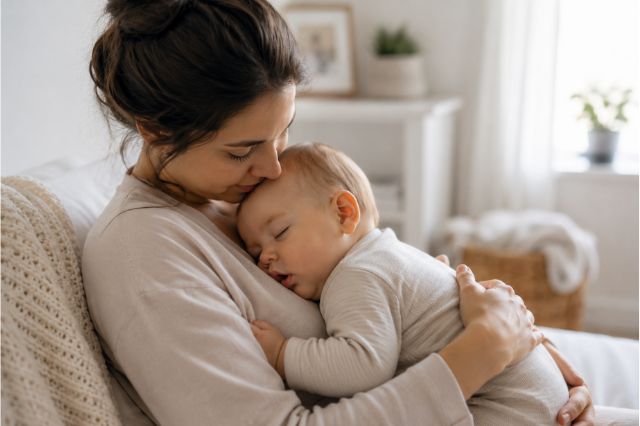
There are various situations in which your baby will sweat. This includes, for example, close physical and skin contact. Many babies sweat while breastfeeding, for instance. Especially in summer, the close contact between baby and mother causes an increase in body temperature.
In addition, sucking at the breast is strenuous for babies. This also applies if you feed your baby with a bottle. It is therefore not surprising that your baby gets warm from the effort and the proximity to you and may sweat.
If your darling often sweats while feeding, you can prevent this: dress your baby more thinly than usual. If it only wears a bodysuit, it can release heat while drinking and will sweat less. If possible, you can also check the room temperature before feeding your baby to ensure a pleasant atmosphere.
Sweaty hands and feet: Also no cause for concern
Another mostly harmless situation is sweaty hands and feet in babies. Have you ever felt that your baby's extremities are sweaty? Perhaps they are even sweaty and cool at the same time. Many parents are concerned about this and assume that the baby is freezing and therefore has cold hands.
In most cases, however, there is a harmless reason behind it. Your baby still needs to practice its temperature regulation: it is not yet fully mature at birth and only develops over time. It is possible that your baby is warm and not too cold.
If hands and feet are cold, you should check the body temperature at the back of your baby's neck again. If the neck and upper body are warm, then everything is fine and the cold extremities are not due to a body temperature that is too low.

Be careful with sweating during sleep
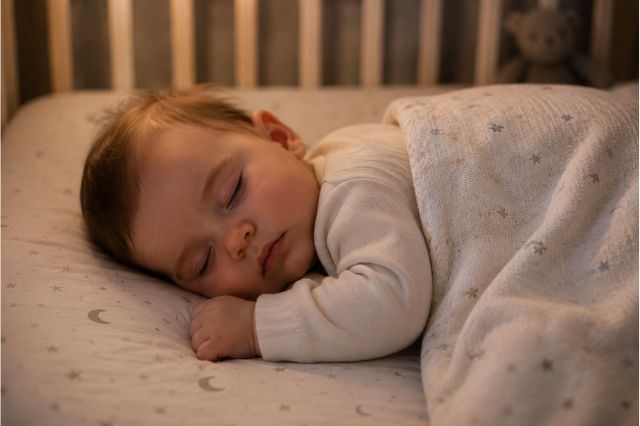
Sweating during breastfeeding and on the extremities is usually no cause for concern. It is a different story, however, if your baby regularly sweats heavily at night. This is because overheating during sleep can be very dangerous for your little one and can promote sudden infant death syndrome.
If your baby sweats during the night, you should take action. Try to lower the room temperature – and do so permanently. It should be around 18 °C: it is not necessary to turn up the heating so that your baby is warm. Quite the opposite, as this can become really dangerous.
Also, make sure not to dress your baby too warmly. If your baby often sweats during the night, you should put them in thinner pajamas. Thick sleeping bags or underlays can also lead to overheating.
Once you have implemented these measures, you should monitor your baby's nighttime body temperature. To do this, place your hand on the back of their neck again and check if they are still sweating.
Cold sweat in babies indicates a fever
If the exertion of breastfeeding or clothing that is too warm is not the reason for your baby's sweating, then they might have a fever. When babies have a fever, they can also sweat as a result.
For babies up to three months old, a body temperature of 38 °C or higher is already considered a fever. Babies and children have a fever from a temperature of 39 °C. Since a high fever can be very dangerous, you should be vigilant if the temperature is elevated.
If your baby is sweating, you should therefore check if they have an elevated temperature. If this is the case, you should consult a pediatrician and have the cause clarified. They might have an infection or there could be another reason behind it.
The general condition of your baby is also decisive. If they seem lively, smile at you, and show their usual behavior, then the elevated temperature and sweating could possibly have been caused by a room temperature that is too high or clothing that is too thick.
However, if your baby seems listless, weak, or even apathetic, you should consult a pediatrician as soon as possible.
6 tips to help you avoid sweating
If your baby sweats regularly, you should look into this topic and identify the cause. Often, it is external factors that promote sweating.
The following tips can help you prevent your baby from overheating:
- Room temperature: If it is too warm, your baby's body will try to regulate its body temperature and it will sweat. Your baby can keep itself warm – it is therefore not necessary to turn up the heating so that the baby is cozy and warm. A normal room temperature of 21 to 22 °C is perfectly sufficient.
- Sleeping temperature: Your baby should be significantly cooler when sleeping. A temperature of 18 to 20 °C is recommended. It is best to avoid heating the bedroom entirely and instead put your baby to sleep in pleasantly cool temperatures.
- Ventilation: Air quality also plays an important role in preventing sweating. For newborns and toddlers, it is recommended to ventilate well before bedtime and supply the room with fresh air.
- Appropriate clothing: Dress your baby appropriately for sleep. Adapt their pajamas to the temperatures and opt for airy materials whenever possible. If your baby sweats at night, they might be dressed too warmly and sweat due to regulation.
- Breastfeeding position: If breastfeeding causes beads of sweat to appear on your baby's forehead, you should change the breastfeeding position. It should be as easy as possible for your baby to drink from the breast. However, an unsuitable position can involve great effort and lead to sweating.
- Pediatrician: If your baby sweats frequently and you cannot identify a reason for it, you should visit your pediatrician and describe the situation. Your baby will then be given a thorough check-up.
If your baby is too warm, they will sweat. The previous chapters have shown that sweating can be caused by a wide variety of factors. Often, parents can achieve a significant improvement in the situation with simple steps such as a lower temperature and thinner clothing.
Consult a doctor in case of fever and groundless sweating
Many parents find it difficult to correctly interpret their offspring's sweating. Is it a fever or an infection? Or is it just clothing that is too warm? It is important that you observe your baby closely and can categorize their behavior.
We summarize for you in which situations you should consult a doctor:
- Your baby sweats heavily at a moderate room temperature, even though they are dressed in airy clothes and are not overly active.
- Your baby has a fever, appears weak, and has no appetite.
- Your baby suddenly starts sweating heavily for no apparent reason.
- Your baby's sweating persists and does not stop even with thinner clothing or lower temperatures.
Sweating is a sign that your baby's body seems to be regulating its temperature. An infection or illness could possibly be the cause, which is why you should consult a doctor if sweating occurs regularly without an obvious reason.

Automatic baby hammock from swing2sleep: An airy sleeping place for your baby
If you often discover cold sweat on your baby, a sleeping place that is too warm could be the cause. Many parents and grandparents want their baby to be cozy and therefore place them on a fluffy duvet cover, cover them with cuddly blankets, and dress them thickly.
However, this is not necessary at all and tends to have the opposite effect: Instead of sleeping restfully, the baby sweats heavily.
A good alternative is the automatic baby hammock from swing2sleep. It serves your baby not only as a sleep aid, but also as a cozy sleeping place. To do this, you place your baby in the hammock, where they lie particularly comfortably. They feel secure because the closeness reminds them of their time in the womb. They are then rocked to sleep with gentle up-and-down movements.
The spring mattress, with its skin-friendly material, ensures a pleasant temperature and good ventilation. This makes it easier for your baby to fall asleep and enjoy a restful night's sleep.
Take a look at the innovative automatic baby hammock from swing2sleep and let yourself be inspired!
Why is my baby sweating cold?
Cold sweat often occurs when your baby sweats first and the damp skin then cools down. This can happen after crying, lots of movement, or if the sleeping environment is too warm.
Check clothing layers, the sleeping bag, and room temperature, and see if your baby otherwise appears awake and rosy.
If your baby seems very lethargic, unusually pale, or if you notice other abnormalities, please seek a medical assessment.
What does cold sweat mean in a baby?
Often there is something everyday behind it, for example overheating, a warm sleeping bag, or a quick change between warm and cool.
Sometimes babies also sweat when they feel unwell. The overall impression is decisive: breathing, skin color, drinking behavior, and alertness.
If cold sweat occurs repeatedly and you are unsure, a brief medical clarification is sensible.
What can cold sweat mean?
Common triggers are too much heat, clothing that is too thick, or a warm room. A growth spurt or very restless sleep can also increase sweating.
If your baby also drinks poorly, seems conspicuously tired, vomits, or is generally "not like usual," please have it medically clarified.
With babies, the overall picture always counts, not a single symptom.
Why is my baby sweating but has no fever?
Babies do not yet regulate their body temperature so reliably and therefore sweat more quickly, even without a fever. This is often noticeable on the back of the head, neck, or back.
Often it is enough to choose one layer less and ensure a pleasant room temperature.
If sweating is very heavy or your baby seems unusual while doing so, seek medical advice for safety.