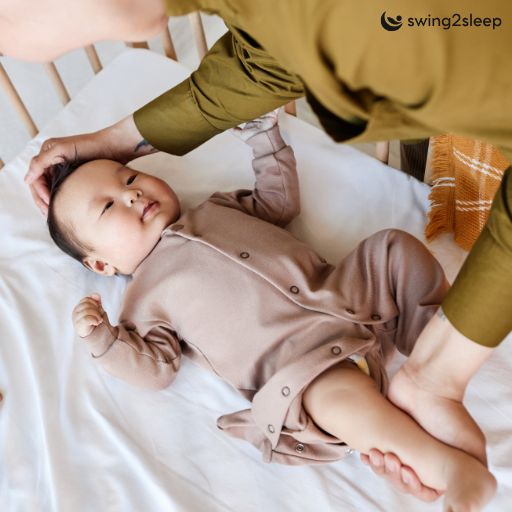



Babies are the cutest things in the world, except at night. At night, the little bundles of joy turn into ruthless tormentors who seem determined to turn their parents into shuffling zombies. Screaming, they keep Mom and Dad on their toes all night long.
First they won't fall asleep, then they wake up constantly. The baby only sleeps in your arms, and to achieve even small partial successes, Mom or Dad must carry them permanently. It just doesn't work with the longed-for baby sleep; the baby cannot be put down.
A few weeks are enough to turn fun-loving parents into wrecks. To some, this image may seem exaggerated; for others, especially parents of high-need babies, it may describe a grim reality.
Yet the situation is by no means hopeless. In this article, you will find some information and tips to help you get through this phase better and more relaxed.

Baby only sleeps in your arms: why your baby won't let you put them down
First of all, it is important to realize why your baby simply cannot do otherwise. The cause is found in prehistoric times. Back then, dangers lurked everywhere and a sleep that was too deep and sound could have meant death for babies. That is why nature equipped them with a safety mechanism.
The little ones woke up again and again to make sure they were still in familiar safety. If signs of danger appeared, they sounded the alarm by screaming loudly. This mechanism has remained with us to this day.
When the child wakes up, the first thing they check is whether all conditions in the environment are still the same as when they fell asleep. If this is not the case, because the pacifier or the pleasant rocking during falling asleep is missing, this is an alarm signal for your baby.
Movement as the key to peaceful baby sleep
If, on the other hand, your offspring wakes up in a carrier, in the stroller, or in your arms, they feel safe because they feel the movement. This calming effect can be traced back to the time in Mom's belly, the epitome of safety and security.
There, the baby was exposed to constant movement. So when they wake up from the deep sleep phase and perceive movement, there is a good chance they will peacefully slumber on. Therefore, movement can be a great help in the individual sleep phases.
However, this has one disadvantage: as soon as the movement stops, for example because you put the child down, you are back at the starting point. The swing2sleep can provide a remedy. In the following interesting video, you will find out why putting a baby down can be so difficult or why they wake up again and again after being put down.
Falling asleep alone in bed? Never!
Many a parenting guide recommends that babies should be accustomed to their own bed as early as possible. In some cases, this may be successful, but not infrequently the attempt becomes an equally frustrating experience for parent and child. Here, too, a look at the Stone Age helps. Babies are carried young.
This means they are naturally designed to be in their parents' arms. Accordingly, the need for physical closeness is great. Therefore, it is not surprising that your baby much prefers falling asleep in your arms than alone in bed, because this gives them security. Especially in the first few months, many parents swear by co-sleeping in the parents' bed.
Valuable tips: Breathe!
The mother's breathing reminds the baby to breathe for themselves through the sound of inhaling and exhaling, the rising and falling of the chest, and the exhaled carbon dioxide. This is a safety system that kicks in if the baby's breathing should ever falter.
Sleeping alone represents an overall neurobiological crisis for the child because, in such a situation, they are left to themselves and their basic needs, but are not equipped for it. In addition, body contact helps the baby to regulate vital bodily functions such as breathing, temperature, oxygen saturation, and blood pressure.
Alone in the crib: What your baby needs
It is questionable when the right time has come to banish the baby from the parents' bed or even the bedroom. In the so-called Western world, which we quietly equate with "civilized," we would prefer to have our bed back to ourselves after six months. In most other parts of the world, very small babies are always near an adult, are carried in slings so that the parents have their hands free, and many babies cannot be put down during the day.
In the non-Western world, it is considered completely normal for small children to be snuggled up to their mother almost constantly. After all, this is the body in which they spent nine months. Consequently, the family bed is considered normal in most other cultures.
The fourth trimester – postnatal pregnancy?
Quite a few babies struggle with adjustment difficulties after birth. In the mother's womb, it was not only warm and cozy, it was also never bright and certainly not loud.
The baby was in permanent contact with the mother, never alone. The changes that birth brings are so severe that the baby longs to be back in mama's belly for the first period of time.
Does this mean that the child was basically not ready to be born yet? In fact, in a certain sense, that is true.
The US pediatrician Dr. Harvey Karp speaks of a fourth trimester of pregnancy in his book "The Happiest Baby on the Block." According to his theory, the child needs at least another three months—others assume about nine months and still others twelve months—until the child is over the worst of it.
The reason for the (too) early birth of human babies is simply that the head would otherwise be too large for the vagina. From this perspective, that the first period after birth is virtually a continuation of the pregnancy outside the body, the thought of letting the child sleep alone seems quite absurd.
What to do if the baby won't let you put them down?
At first, the realization that you aren't actually finished with the pregnancy might be shocking or even frustrating. In fact, however, this is the key to solving the problem.
This solution will also demand a lot from you, but compared to the ordeal of a constantly crying and unhappy baby and regular sleep deprivation, it could feel almost like a vacation. By knowing the causes of the sleep problems, you can respond directly to the child's needs.
Since the baby should actually still be in the womb in terms of its development, you can try to simulate the conditions that prevailed there as closely as possible during the first weeks of life.
Every child works differently
Give the baby as much security as possible. This includes, for example, the immediate fulfillment of the baby's needs. In the womb, the child was nourished by the umbilical cord without having to draw attention to itself by being hungry first.
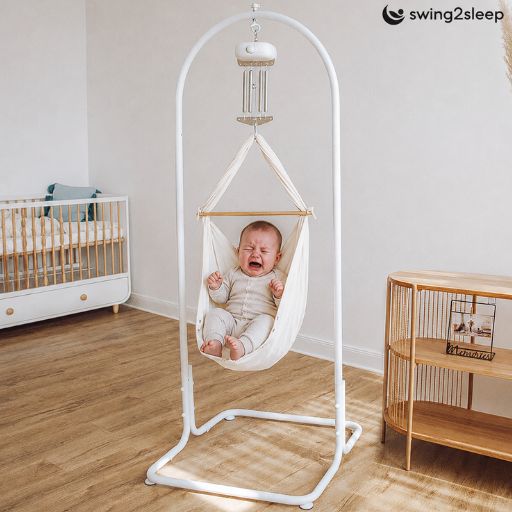
In the "fourth trimester," it is important to feed the child as soon as they are hungry and to give them closeness immediately. In the first year, this is a necessity and has nothing to do with spoiling them. You can also mimic the tightness or the sounds in the womb, for example by swaddling the baby or placing them in an automatic baby hammock from swing2sleep.
At the same time, you can soothe them with sounds like humming or buzzing.
Carrying the baby around (ideally with a wrap or a baby carrier) also has a calming effect on the little one.

White noise when putting them down
So-called white noise sounds very similar to your baby as the sounds they perceived in the womb, and there were quite a few of them: the flow of blood, the hissing of air when breathing in and out, or the vibration of the vocal cords.
The constant noise can also help your child sleep through the night because it masks irregular and mostly unfamiliar background noises for the child, such as cars, slamming doors, etc. Dr. Ralph Pascualy, the medical director of the Northwest Hospital Sleep Center in Seattle, explains that our brain is constantly searching for sensory impressions.
During sleep, even the smallest sound, like a passing truck or a creaking floorboard, can activate the brain and thereby interrupt sleep. Constant white noise gives the subconscious something to focus on, making it less easily disturbed by irregular noises.
Here is our favorite trick with our 3 children
In addition to the swing2sleep, which we originally developed for our own colicky baby, we had another "secret weapon" at our disposal that worked wonderfully for all our children: If your baby is already about three months old and still prefers to fall asleep in your arms, it helps enormously to have a little friend who is there when the child is supposed to fall asleep.
However, we are talking about a little friend who smells like Mom. Take a teddy bear or a comforter of your baby's into bed with you for a few nights. This will cause the teddy to take on your natural body scent. Your baby will then have the feeling of being close to you when they perceive your scent through their friend.
Between light sleep and deep sleep
In the early days, your baby is in an absolute crisis situation because they were expelled from the nourishing womb before they were actually ready for it. That's why you should try to respond precisely to the needs of your little new citizen of the world: security, carrying and rocking, quiet noises and dimmed light, warmth and familiar smells. Let them want for nothing, especially not closeness and love.
If the baby wants to be carried, then carry them as long as possible; if they want to be rocked, then rock them until your arms fall off, or you can simply let an automatic baby hammock from swing2sleep do the job.
The main thing is that you are happy!
One last "hot" tip: The transition from the swing2sleep to the crib is more successful if you pre-warm the bed with a hot water bottle. Who wants to get into a cold bed? I still don't like that to this day! ;-).
FAQ: Baby only sleeps in arms
What can I do if my baby only sleeps in my arms?
First of all: This is completely normal, especially in the first months of life. Closeness, movement, and body heat provide your baby with security. It can be helpful to transfer these conditions gradually, for example through gentle rocking, steady noises, or a quiet sleeping environment. It is important to introduce changes slowly and not to work against your baby's rhythm.
How to sleep if the baby cannot be put down?
If putting them down is not working right now, baby carriers, strollers, or gentle rocking movements are often a good support. Many babies continue to sleep better if a slight movement is maintained. A fixed bedtime routine can also help, as repetition provides security.
Is it okay if a baby sleeps in your arms?
Yes. Sleeping in your arms is not harmful to babies and does not spoil them. On the contrary: Closeness strengthens the bond and helps the nervous system to regulate itself. As they mature, most babies develop the ability to fall asleep without physical contact on their own.
How do I break my baby's habit of falling asleep in my arms?
Not through abrupt weaning, but through gentle transitions. For example, put your baby down when they are already drowsy but not yet in a deep sleep. Stay with them, speak softly, or place a hand on their tummy. This way, your baby learns step by step that they can fall asleep safely even without being in your arms.