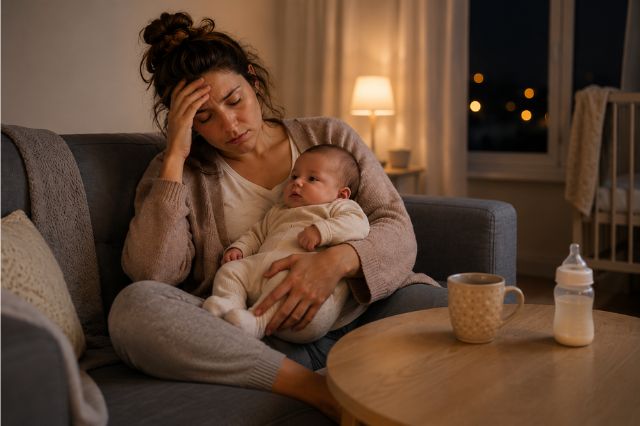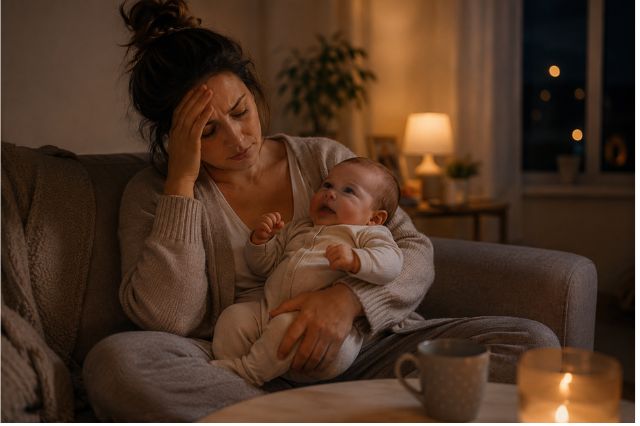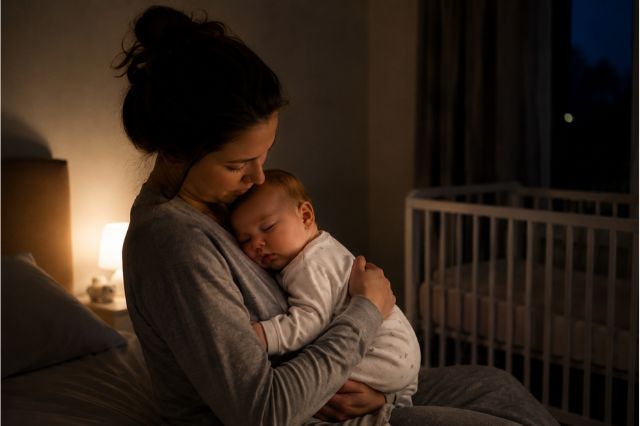



The fact that children sleep in their parents' bed has a bad reputation and is almost frowned upon. Many parents fear that they are spoiling their offspring too much and raising them to be dependent. And will they perhaps never have their bed to themselves again because the little one refuses to move into their own bed?
In this article, we look at why such concerns are misplaced and how co-sleeping can be helpful for the whole family.
Does my baby have to fall asleep alone?
In our culture, the concept of apartments with multiple rooms only gradually became established among the population about 200 years ago. Before that, it was quite common for the entire family life to take place in a single room. Accordingly, the sleeping area was also shared.
From an evolutionary point of view, it is therefore not intended at all that babies should sleep separately from their parents at night, and in a large part of the world, this idea would still be considered completely absurd today.
Today, supposedly modern educational concepts are increasingly being put to the test, and a trend back to a more natural and species-appropriate way of dealing with children has set in. In addition to many other areas, this is also reflected in the question of so-called co-sleeping.
Co-sleeping is a modern term for an ancient practice: children sleeping in the parental bed. What is smiled at by many parents can, however, certainly offer advantages for the whole family. Perhaps your baby doesn't have to fall asleep alone at all.

Learning to fall asleep alone: When is the right time for new sleep habits?
All parents want their baby to sleep well. However, every baby has its very own sleep behavior: while some fall asleep directly in their crib, other children need a fixed bedtime ritual and only find peace when mom or dad is there.
In the long run, this can lead to a complicated sleep situation: many parents wonder when their baby will fall asleep alone and how they can support them in doing so. Because permanent sleep accompaniment can really fray the nerves of new parents.
It is difficult to say across the board from when a baby can fall asleep alone. Keep in mind that your baby is just as individual as you are – it does not stick to guidelines or average values. Some babies can already take a nap alone at five months and no longer need mom and dad for it. Others need a little longer until they can lie down to sleep alone.
Many babies also go through certain sleep phases: although they can already fall asleep alone, they occasionally still need physical closeness to find sleep. This is also completely normal and part of your baby's natural development.
Supporting baby when falling asleep in their own room
Do you feel that your baby should slowly learn to fall asleep alone? This is the case, for example, when both you as parents and your baby are dissatisfied with the current sleep situation. You can start a first attempt when your baby is currently relaxed and not going through a developmental leap.
The following tips can help you:
- Create a sleep log and record how much sleep your baby needs, at what times it falls asleep best, and where it finds sleep best (crib, stroller, etc.).
- Introduce a fixed evening ritual in which the same sequence is intended to prepare your baby for the night's sleep. You can sing a lullaby, cuddle, or read a book – a fixed routine with a regular bedtime will help the baby become sleepy and fall asleep.
- Create optimal conditions for falling asleep: the nursery should not be too warm, you should minimize environmental stimuli, and remove all blankets or pillows from the bed.
- Find a suitable sleeping position for your baby. It is best if it lies on its back, as it can then breathe best.
If you want to support your baby in falling asleep alone, these tips can help you. Perhaps you could let your child sleep alone in their bed during the day as a first attempt.
However, it is also completely normal that your child first has to get used to the new situation and may have problems falling asleep and staying asleep.
It is important that you do not exert pressure and also accept regular waking up – you will help your child better with a sense of security than with pressure and punishment.
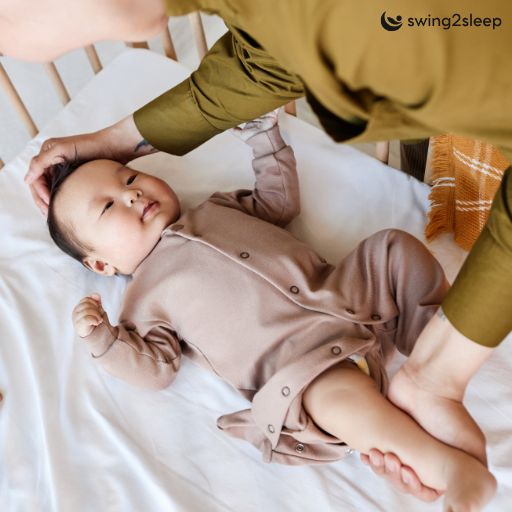
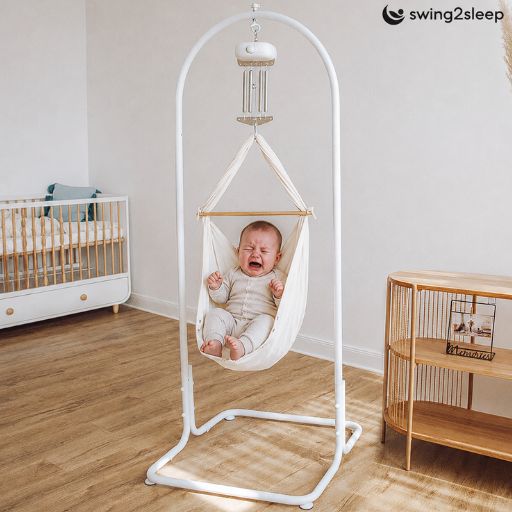
Would you like to let your child fall asleep alone? What could help you is the automatic baby hammock from swing2sleep. It was developed to support babies in falling asleep alone.
We specially designed the hammock so that they feel safe and secure. These are the best conditions for a restful sleep.

Sleeping through the night with a baby in bed: Not always so easy
Admittedly: It can get a bit exhausting when children's steps can be heard in the middle of the night and the bedroom door opens so that your child can slip into the room and back into bed with you. Mom and Dad slide aside and make room for their little offspring.
What gives children security sometimes means little sleep for parents. Not everyone involved finds the tangle of elbows, knees, and arms cozy. In smaller beds, it can also get quite cramped and, especially in summer, very warm.
For your child, however, it means safety and familiarity when they feel physical contact and your proximity while sleeping. So it's not such a bad thing if babies and toddlers sleep with their parents.
Falling asleep alone is not intended by nature
Anyone who lets their child sleep in bed with them nowadays is quickly looked at askance. The assumption persists that children could be coddled and spoiled if they sleep with Mom and Dad instead of in their own room.
Or that the children would neither learn independence nor ever be able to be evicted from the parental bed again.
The good news: All these fears are completely unfounded and long-standing outdated parenting concepts are slowly changing. Instead of suppressing the child's most basic instincts by force, they are increasingly being recognized as childhood needs.
And from this grows the parental responsibility to also meet these needs.
One of these instincts is to seek the proximity of the parents, especially during sleep. Therefore, it is completely normal for children to push into the parental bed and not want to fall asleep alone.
Evolutionarily speaking, the child simply could not survive in the past without the protective proximity of the parents. Some babies also only sleep in your arms because of parental proximity. Therefore, the attachment system is activated in a tired child.
Another factor is that human babies are basically born much too early. Unlike other mammals, their maturation at the time of their birth is not yet sufficiently complete. Actually, they would have to remain in the womb for another 6 months.
Then, however, their little head would no longer fit through the birth canal. This means that babies still need to "mature" after birth, and for this, the proximity of Mom and Dad is absolutely necessary.
Dependent children through co-sleeping
It is a persistent misconception that babies who sleep a lot with their parents remain dependent and grow up to be spoiled children. The opposite is true: those who are given enough closeness and security by their parents as a child later mature into a confident and independent adult.
It has even been shown that co-sleeping is beneficial to intelligence! In addition, these children are breastfed more often at night, which is good for their health, and the close relationship with the parents has a positive effect on the psychological stability of the child.
But another point should not be neglected either: children sleeping in their parents' bed do not perceive going to bed as a punishment, but as something beautiful and relaxing. It is quite different for children who are forced to fall asleep alone.
They are under great stress when going to bed, and soon crying and sleeping become inextricably linked for them. The risk of suffering from sleep problems in the future increases significantly as a result.
Are there risks?
There are risk factors that can put the child in mortal danger when sleeping in the parents' bed: soft mattresses, a waterbed and thick pillows.
And if the parents are sedated or intoxicated by drugs, medication or alcohol, children have absolutely no business being in the same bed.
Smokers exhale residual pollutants while they sleep, which can have health consequences for the child, and people suffering from obesity should also not share a bed with a child.
If none of these factors are present, the offspring may come into bed. The baby should sleep roughly at the level of the mother's breast so that it has direct access to food at night.
If the parents have long hair, they should tie it back at night. The mother's nightgown should also not have any loose ribbons that could strangle the child.
If these simple safety precautions are followed, nothing stands in the way of nightly cuddling. In fact, sleeping in the family bed is often even safer than in their own bed.
To what extent do parents benefit from falling asleep together?
Most parents probably react slightly annoyed when they have a child in bed who constantly kicks, lies crosswise or pulls the blanket away from them. Yet parents also benefit from the family bed.
Mothers sleep best when they know their baby is safe – ideally in their direct proximity. And fathers benefit because they are not constantly disturbed when the mother gets up to breastfeed. If the baby is hungry, it is quickly taken care of and falls back asleep quickly afterwards.
This means that neither mother nor father are completely jolted out of their sleep. After a short interruption, they can go right back to sleep.
It gets even better with the motorized automatic baby hammock from swing2sleep. It is the perfect jump-start for baby sleep. Your child lies safely and comfortably in the hammock and is gently rocked. In combination with the pleasant sense of enclosure, this creates conditions that remind the baby of its time in the womb. Relaxed and secure, it quickly falls asleep.
Please note that the swing2sleep is purely an aid for falling asleep. It is not a substitute for a bed or a crib.
Another widespread prejudice says that you won't get your child out of your bed once you've allowed them to sleep with you a few times. This claim is also not supported by anything. In fact, most children sooner or later prefer to sleep in their own bed of their own accord.
But of course, you can also set a limit yourself from the outset. There is nothing against agreeing that your child is only allowed to sleep in your bed during the first year, for example, and afterwards only as an exception.
Conclusion: Don't pressure your baby to learn to fall asleep independently
Contrary to popular belief, letting your child sleep with you in the parental bed has nothing to do with coddling or spoiling. Especially small children are extremely dependent on closeness and love for their development.
This is not a demand, but a natural need, because the child is basically born too early. For this reason alone, spoiling such a small baby is not possible at all.
Rather, you spoil or coddle your child when you constantly do things for them that they can already do themselves – like tying their shoes or carrying their school bag. Only then are they taught that others will do the work for them and they don't have to make an effort. And that is exactly what leads to a lack of independence later on, not the warmth and security in the parental bed.