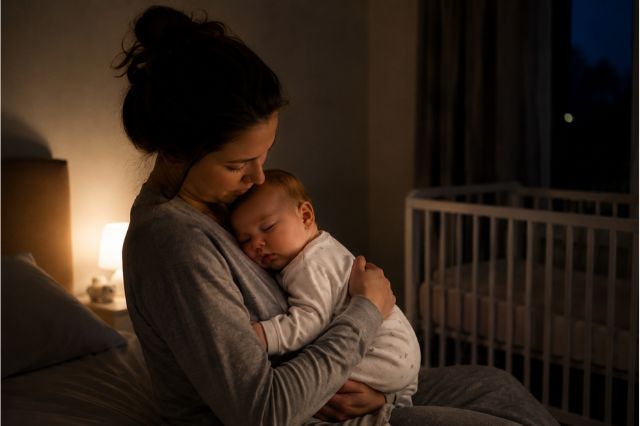



The sight of a peacefully sleeping baby is priceless for parents. The peace and innocence emanating from a sleeping child are of immeasurable value. But sometimes this peace can be disturbed by a nightly nightmare or the so-called "night terror," giving parents a real fright.
When your baby or toddler suddenly screams in the middle of the night and seemingly cannot be calmed down, it can be frightening. But don't worry, three to six percent of all children are affected by this sleep disorder, making it one of the most common arousal disorders in childhood.
What exactly happens during a night terror in babies and toddlers? How should you act during a night terror, and when does it make sense to introduce your little one to a pediatrician? We have answered these and other questions for you in the following article.
Pavor Nocturnus: Night terrors in babies and children
The night terror, also known as Pavor Nocturnus, is a nocturnal phenomenon that occurs frequently, especially in toddlers. This sleep disorder is known for causing an uproar for parents in the middle of the night. Most children are struck by night terrors in the first third of the night.
This parasomnia most commonly occurs in the first two to three hours after falling asleep. Once the episode is over, most little ones don't even remember what happened.

Night terrors in toddlers and babies
A night terror is a sleep disorder in which children wake from a deep sleep in the first half of the night and appear extremely anxious or terrified.
It is not uncommon for the phenomenon to begin with a never-ending scream from the little one, along with eye movements and other movements that are mostly uncontrolled.
It can be frightening for parents to see their child in such a state, but it is important to know that in most cases, night terrors do not pose a serious danger to the child.
The phenomenon is related to the child's development, which is why children between the ages of two and six primarily suffer from night terrors.
The difference between a nightmare and a night terror
Before we delve further into night terrors, it is important to understand the difference between a nightmare and a night terror. A nightmare is an intense dream often accompanied by fear or terror and usually occurs during REM sleep, i.e., in the later sleep phases.
Children can have nightmares that wake them up and frighten them, but they are usually responsive and can be comforted by their parents. In contrast, a night terror occurs during the deep sleep phase, usually in the first two hours after falling asleep.
During a night terror, the child is not responsive and seems to be in a state of confusion or fear and is disoriented. This can be terrifying for parents as they cannot easily calm their child.
It is not uncommon for your child not to even know what happened during the night the next day, as they do not fully wake up and therefore have no memory of the event. Thus, the affected child rarely experiences any psychological distress.
Scientific background of night terrors
But what exactly is a night terror? To better understand night terrors, let's take a look at the scientific details to better understand what happens in your little one's body during a night terror. Night terrors are closely linked to the nervous system.
During sleep, your darling goes through various sleep phases, including deep sleep. In this sleep phase, bodily functions such as breathing, heartbeat, and pulse are at a minimum, and the brain is in a deeper state of rest.
Sometimes it can happen that a child moves out of this deep sleep phase but does not fully wake up. In this semi-awake state, parts of the central nervous system can become active while others remain inactive.
This leads to night terrors and sleepwalking, both of which are among the most common arousal disorders.
Night terrors in older children
While night terrors in babies and toddlers occur most frequently, they can also occur in older children between the ages of two and six. In older children, however, night terrors may be less pronounced as their nervous system is already more mature.
Overall, it is important to understand that night terrors occur within the context of a child's natural sleep phases and do not typically indicate a serious problem or psychological disorder. It is a temporary disturbance that often disappears on its own as the child grows and develops.
Dealing with and preventing night terrors
Parents are often at a loss when confronted with their child's night terrors. It can be difficult to know how best to react.
Here are some steps that can help you deal with a night terror:
- Stay calm: The most important step is to stay calm yourself. Remember that in most cases, night terrors are not dangerous. Your little one will calm down when they are ready and will not suffer any harm.
- Do not wake them: Do not try to wake your child. Since they are in a deep sleep, they will not be responsive and waking them can lead to confusion.
- Safety measures: Make sure your child's environment is safe. This way you can prevent them from hurting themselves if they move around in their sleep.
- Wait patiently: Most night terrors only last a few minutes. Wait patiently until your child calms down on their own.
- Sleep hygiene: Ensure good sleep hygiene by establishing regular bedtimes and calming rituals to reduce the likelihood of sleep disturbances. Letting the evening wind down quietly can also help prevent night terrors.
- Keep records: It can be helpful to keep a sleep log to identify patterns and triggers for the night terrors. This can help you and your pediatrician solve the problem should your little one experience distress.
When to see a pediatrician?
In most cases, night terrors in children are harmless and temporary. However, it is important to know when to consult a pediatrician to ensure there are no other sleep disorders or health issues present.
You should see a pediatrician if:
- your child's night terrors occur constantly and you are worried about their sleep quality.
- the night terrors persist beyond the age of six.
- other symptoms or changes in your child's behavior occur that worry you.
The medical professional can perform further examinations and, if necessary, recommend treatment or intervention.
FAQ: Baby night terrors
How do night terrors manifest in babies?
A night terror usually manifests as sudden, panicked screaming from sleep. The baby appears frightened, often has their eyes open, but does not respond to being spoken to or attempts to comfort them. Physically, rapid breathing, sweating, or restless movements may occur. After a few minutes, the child usually calms down on their own and does not remember it the next day.
At what age do night terrors begin?
Night terrors occur most frequently in toddlerhood between about two and six years of age. In rare cases, younger babies can also be affected, especially if their nervous system is still very immature or highly overstimulated. As the brain develops, night terrors usually disappear on their own.
Why does my baby have nighttime screaming fits?
Nighttime screaming fits can have various causes. In addition to hunger, discomfort, or overtiredness, a night terror can also be the cause. In this case, the baby does not wake up completely but is in an intermediate state between deep sleep and wakefulness. Stimuli, developmental leaps, or a restless daily routine can encourage such episodes.
Can infants have night terrors?
Yes, even infants can show episodes similar to night terrors in rare cases. However, these are significantly less common than in toddlers. Often, these are more likely to be immature sleep phases or overstimulation rather than a classic night terror. If the episodes occur frequently or are very intense, they should be discussed with a pediatrician.