


Many children sleep poorly in their first few years – much to the chagrin of their parents, who had certainly imagined things quite differently. But what are the causes, and what can be done about it? In fact, sleep problems can have many causes, but keeping a sleep log for the baby offers an excellent way to make problems visible in order to then specifically develop gentle solutions.
Sleep log for the baby: The key to the solution
When a child constantly wakes up at night, the frequent interruption of much-needed sleep eventually takes its toll on all parents. It may not be much comfort, but you are not alone. In fact, many people feel this way. While sleep problems in children can disappear all by themselves after a few months, two- or three-year-olds also frequently keep their parents on their toes, especially at night.
The good news: Here, too, the problems resolve themselves sooner or later thanks to the natural development of the children.

Until that time comes, however, you as parents are not helplessly at the mercy of the situation. There are certainly several measures you can take to noticeably and quickly improve the difficult situation. At the beginning, it is recommended to keep a sleep log. It helps you to track down the causes of the sleep problems. Only then can you really tackle the problem at its root.
At around 6 months, the baby's natural sleep pattern is mature. The children have then reached an age at which they fall asleep at certain times and can sleep through the night (for a baby of this age approx. 4–6 hours at a time).
Causes for babies having trouble falling asleep or staying asleep are as numerous as grains of sand in the Sandman's pouch. But perhaps it is also because your little treasure is in bed too early or for too long? Does he possibly sleep too long at noon and is therefore not tired in the evening? A sleep log can bring clarity here.
Why a sleep log?
The sleep log determines your baby's actual sleep needs
Every child needs a different amount of sleep, even newborns. While one child blissfully slumbers for a good 17 hours a day, another, much to the parents' annoyance, gets by with significantly less sleep. For them, 12 hours might be enough. Unfortunately, this sleep behavior will not change significantly in the coming months and years.

With the sleep log, you get a concrete overview of your baby's actual sleep needs.
This provides you with a solid guide that gives you security and represents a first step towards getting sleep problems under control or preventing them from the outset. It is best to keep the sleep log over a period of 2–3 weeks, to determine how long your baby, for example, just lies in bed without actually sleeping. Once the actual sleep requirement becomes clear, you can better plan sleep times over the 24 hours of a day.
Connections between meals and crying
Some babies have allergies or intolerances. This often causes them problems falling asleep or staying asleep. But also for babies who suffer from colic or where too much swallowed air causes flatulence, the tummy hurts especially in the evening, and they toss and turn restlessly. Sometimes the causes are not immediately apparent to us. With the sleep log, however, you can track them down quite quickly if you compare your entries from several weeks.
Connections between daily schedule and sleep problems
Many parents have only a vague idea of how many new impressions their baby actually processes during the day. Their brain is constantly running at full speed, and the filter to separate the important from the unimportant has yet to develop. Especially babies suffering from regulatory disorders can quickly become overstimulated by too many visits from friends and acquaintances or by too many activities. They then need a calmer and more structured daily routine than other children. With the help of the sleep log and your notes on sleep patterns, any connections between the day's activities and possible sleep problems quickly become apparent.
Problems with the sleep-wake rhythm
Only a few babies develop their own sleep-wake rhythm by themselves. Most need our help for this. Often we don't even notice when our daily routine doesn't fit with the sleep-wake rhythm of our baby. To avoid such a burden, fixed times and evening bedtime rituals are recommended, especially for babies with regulatory disorders. The sleep log helps you to bring your daily routine more in line with the child's rhythm because it shows which sleep and feeding times best suit their internal clock.
The child's sleep habits – How much sleep does my child actually need?
With the following questions, you can easily check and analyze your child's sleep patterns. On this basis, you can then decide whether action is needed.
- When do you put your child to bed?
- When does your child get up in the morning?
- How many hours does it spend in bed at night?
- How long does your child take to fall asleep in the evening?
- How long is your child awake in total during the night?
- How many hours does your child sleep at night (actual sleep time)?
- From when to when does your child take their nap(s)?
- How many hours does your child sleep during the day?
- How many hours of sleep do day and night add up to?
Results of a sleep log
The sleep log also helps you answer the questions above. In this way, your child's sleep pattern becomes even more apparent.
For example, it may become clear that your baby lies awake in their crib for a long time before falling asleep, or that the set bedtime does not fit your baby's natural rhythm at all. It could also show that the child sleeps too much during the day and therefore can no longer sleep through the night.
To make your life easier, we at swing2sleep have created a sleep log template for you, which you can download here for free.

Tips for filling out the sleep log
Record all wake times immediately. If your child is particularly active at night, you won't be able to remember all the times exactly (if at all!) later. If you are jolted out of deep sleep in the middle of the night to perform routine tasks like changing diapers or feeding, your brain doesn't even properly switch to "awake," and after getting up the next morning, you can only remember it vaguely or not at all. Therefore, it's best to write these times down right away.
-
Only record the actual sleep time, not the time spent in bed, because you want to determine how much your child actually sleeps. If your baby stays in bed longer than is actually necessary, this could lead to them simply not being tired out in the evening and at night. Problems falling asleep and frequent waking during the night are then inevitable.
Use different colors to record sleep times. This will give you a better overview. - Also record meals. This allows you to track the daily routine and identify potential connections between feeding and crying phases. This shows at a glance, how often the baby is hungry and whether there is a pattern.
- Also enter crying phases. This log makes your baby's crying phases clearly visible for the midwife or pediatrician. You might even recognize a pattern yourself and can significantly shorten the crying time by gently adjusting sleep times and improving sleep situations.
- Keep the sleep log for at least 2–3 weeks. Since your baby's sleep rhythm can still change daily at the beginning, you should ideally cover a longer period with your records. This also prevents short-term difficult phases such as infections, growth spurts or teething from distorting the results.
Other causes of sleep problems
Intense daily schedule – Overstimulated baby
Many babies are simply overwhelmed by a daily schedule that is too packed. They cannot yet process the many stimuli that bombard them during the day, very well, and this can disturb their sleep. If things are also turbulent in the evening before bed, any prospect of the baby falling asleep without problems is gone.
If you recognize a connection between the daily schedule and your baby's sleep problems, you should reduce all evening activities as much as possible. However, this should be done with a sense of proportion so that everyone involved feels comfortable. Even with such a small baby, you can certainly still receive visitors. Just pay attention to a moderate dosage. The introduction of evening sleep rituals is also a proven measure for babies with regulatory disorders.
Too much or too little sleep?
Every child has a different sleep requirement. Our studies have shown that in some families, parents' expectations do not match their children's actual sleep needs. A baby who lies in bed and sleeps from 8:00 p.m. until 6:00 a.m. is an absolute exception. If your baby stays in bed for too long, they will almost certainly have trouble falling asleep or wake up frequently during the night.
Too little sleep can also lead to sleeplessness
Especially for babies suffering from regulatory disorders, overstimulation and overtiredness can lead to them not being able to wind down at all. They then become increasingly hyper, even though they are actually exhausted. Especially during the day, babies with regulatory disorders find it very difficult to fall asleep. The poor daytime naps additionally ensure that nighttime sleep is also very restless. Many of these children get far less sleep than they actually need and, as a result, become increasingly restless and fussy. The sleep log will show you your child's actual sleep needs so that you can distribute sleep times sensibly throughout the day. In this way, you ensure that your baby receives exactly the right amount of sleep.
Great need for closeness
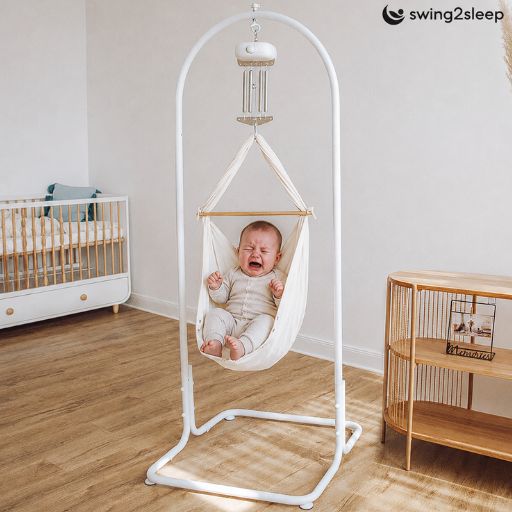
Some babies need a lot of closeness and skin contact. They wake up again and again at night, because they notice in their half-sleep that mom or dad are no longer lying next to them, and they simply feel lost in bed. A good option here could be to let the baby sleep in the parents' bed so that the child gets enough sleep and the parents also find more rest. However, the best alternative is sleeping in our swing2sleep automatic baby hammock. Thanks to the cozy snugness in our high-quality mesh, your baby feels safe and secure – just like back in the womb.
Hunger or thirst?
In particular, babies going through a growth spurt cry a lot, sleep worse, and are very hungry. In such phases, additional feedings can successfully ensure better sleep. If the mother is breastfeeding the child, you should always feed on demand and not according to the clock.
Missing or incorrect rhythm
Even with babies, there are already real early birds and those who simply don't get out of bed in the morning. If the sleep-wake rhythm does not match their internal clock, your baby will not settle down in the evening, and you won't get them out of the feathers in the morning. Fortunately, children's rhythms usually develop on their own over time. Often, the parents' sleep rhythm is simply adopted. Therefore, it is recommended to follow this rhythm very consistently until the baby has gotten used to it.
The nervous system is not yet fully developed
Babies sleep differently than adults. Their deep sleep phases are significantly shorter than ours and the light sleep phases last significantly longer. This is a survival mechanism that Mother Nature has set up this way. The baby wakes up several times to ensure that everything is still okay. If anything has changed, be it that the location has changed or mom or dad is not nearby, they wake up completely and draw attention to themselves by crying.
Over time, the deep sleep phases will also increase in your children. However, babies with regulation disorders sleep even more restlessly than others. They can block out stimuli even less effectively and are therefore completely woken up by even the smallest noise. In contrast, monotonous sounds like humming or white noise help your baby to relax and feel safe.

The swing2sleep also offers your baby a continuous and incomparable sense of security. They sleep deeper and wake up significantly less often. The up-and-down bouncing also reminds your baby of the womb. This makes them feel simply safe and secure, ensuring that the first impressions of this world are safe and wonderful.
Infections, teething, and growth spurts
All parents are familiar with these phases: just as you've gotten used to the baby sleeping through for a few hours at a time, they suddenly start waking up every hour again. Either an infection is coming on, the first teeth are trying to break through, or a growth spurt is in full swing. Such phases occur frequently, especially in the first year of life. The only things that help are lots of closeness, understanding, and strong nerves. Because only once the infection has subsided, the tooth has broken through, or the growth spurt is complete, will a sense of normality return.
Blockages and KISS syndrome
Particularly for mothers who have had a difficult birth, the baby can be very restless. In these cases, a visit to an osteopath usually helps to clarify whether a vertebra might have shifted during birth. This can also be a reason why your baby cries or has trouble settling down. Such vertebral shifts can lead to very painful blockages throughout the body, which, if left untreated, may cause postural problems later on.
By the way
Keeping a sleep log isn't the only effective way to help your baby fall asleep and stay asleep better. The combination of rhythmic movement and a pleasant snugness – as found in our swing2sleep automatic baby hammock – can also work wonders.
The swing2sleep team wishes you restful nights.