

Admittedly: At three years old, my daughter is no longer an infant, but throughout her young life she has been a particularly sensitive and very empathetic person. Perhaps because of this, or precisely because of it, she is very susceptible to the individual phases of the moon.
Since she was born, I have been able to observe every month anew that a few days before and directly on the full moon she sleeps not only poorly, but particularly poorly, and I assume that other children experience the same.
I have often wondered why this is. Is there a reason why babies and children sleep extremely poorly on these nights? I went in search of answers.
Sleep disturbances during a full moon: Sensitivity or imagination?

Initially, the results of my search were quite sobering. Science did not seem to see any evidence of a connection between the individual moon phases and altered sleep behavior.
However, I dug further, and after extensive research, I actually found studies that pointed to connections between unexplained phenomena and lunar cycles. For example, in 2013, the chronobiologist and scientist Christian Cajochen published a study in which he retrospectively evaluated the sleep data of 33 people.
In it, the physician compared falling asleep time, sleep duration, deep sleep phases measured by EEG, and melatonin levels on days before, after, and during a full moon with data measured on other days of the lunar cycle.
What he found is amazing: On evenings around the full moon, the subjects took an average of five minutes longer to fall asleep. They also slept 20 minutes less and the deep sleep phases were shortened by 30 percent. In addition, the level of the sleep hormone melatonin was lower.
The moon: A force of nature
It suddenly became clear to me what an enormous influence the moon has on nature and the rhythm of the world. It controls the tides and moves billions of tons of water through its gravitational pull. It influences all life on our planet and we are part of it.
Therefore, we are also subject to its influence. On the one hand through the nightly light conditions and on the other hand possibly also through gravity. After all, we humans also consist of 70 to 80 percent water. Even in today's world, where many magical wonders have already been scientifically debunked, many people are still convinced of the effect of lunar attraction – and want to preserve this belief.
Some foresters, for example, follow certain moon phases when felling their trees because they swear that the wood then has a better and firmer consistency. In agriculture, too, the lunar calendar is used more often than one might think when sowing and harvesting.
The increase in the birth rate during a full moon is considered folk wisdom by many, and the connection between the moon phases and pregnancies as well as the female cycle has been the basis for sagas, myths, and legends since time immemorial.
What moon phases are there?
In the following, I would like to briefly introduce you to the moon phases and the characteristics attributed to them. Perhaps you will find a possible explanation there as to why your children behave more conspicuously on some days than on others.
The moon phases are usually divided into four quarters, each about a week long. A complete moon phase cycle from one new moon to the following new moon is also called a lunation and lasts an average of about 29.5 days.
Commonly, a distinction is made between new moon, waxing moon, full moon, and waning moon. "Waxing moon" is the name for the shape of the moon during the entire period between new moon and full moon, when the part of the moon visible to us and illuminated by the sun gradually becomes larger. Correspondingly, the moon shape between full moon and new moon is called "waning moon".
Halfway between new moon and full moon lies the "waxing half moon" and in the middle between full moon and new moon accordingly the "waning half moon". At these times, we see the moon disk exactly half illuminated.
The new moon

The actual time of the new moon, also called "empty moon" in Switzerland, is very short. It is the exact moment when the moon stands exactly between the Earth and the Sun for a moment. However, because it cannot be seen with the naked eye for about 35 hours, except during a solar eclipse, it is mistakenly assumed that the entire period between the last visible waning crescent ("old light") and the first visible waxing crescent ("new light") is called the new moon. Strictly speaking, however, it is actually only this short, mathematically defined point in time.
During the new moon, things should be let go. It is the time that lets us and our babies come to rest – parents often observe that their babies are calm all by themselves during this phase. In this phase, you can better process what has happened. At the same time, now is the best time for a new beginning. This phase of the moon is particularly well suited for setting new goals or tackling old projects anew.
Waxing moon (approximately 13–14 days)

Here the moon begins to wax. This means that the right side of our satellite, as seen from our perspective, is gradually being increasingly illuminated by the sun. During this time, not only we but also our children are bursting with energy. The more the moon waxes, the more babies run at full speed.
Thus, it also becomes clear why the little ones sleep so poorly at the end of this phase. Our babies' energy is then at a maximum. This phase is excellent for implementing plans or doing things that require a lot of energy.
The full moon
 Full moon is the moon phase in which the sun and moon are in opposition to each other, i.e. seen from the Earth in opposite directions. Analogous to the new moon, the specific time of this constellation is only quite short, but in common parlance we speak of a full moon as long as we can see the full moon disk. During a full moon, the moon reaches its maximum brightness. If the moon is in the plane of the Earth's orbit or slightly above or below it, a lunar eclipse takes place.
We often experience this moon phase as particularly tricky. We sleep poorly and are much more sensitive than on other days. Babies have a very high need for physical contact at this time and ideally do not want any separation from their caregivers at all.
This day is particularly well suited for shifting down a gear, not planning anything, and possibly taking the baby into the parents' bed. Everything seems to have a double effect on this day – be it sleep disturbances, nervousness, anxiety, or even regulation disorders. Similarly, the effect of herbs or herbal medicines is also intensified during a full moon.
The full moon also has a strong effect on babies. Many infants become noticeably restless, sleep only briefly, and wake up. This may also be because the moon shines particularly brightly on this night.
Waning moon (approximately 13–14 days)

With the waning moon, it gradually moves more and more out of the sunlight. In this phase, we feel active and cheerful. We are more content.
Tip for better sleep: the automatic baby hammock from swing2sleep
Even if the influence of the moon on our behavior and our sleep is scientifically controversial and not proven, particularly sensitive people are convinced of its effects. Ultimately, such experiences are certainly subjective, but for those affected, they appear to be very real.
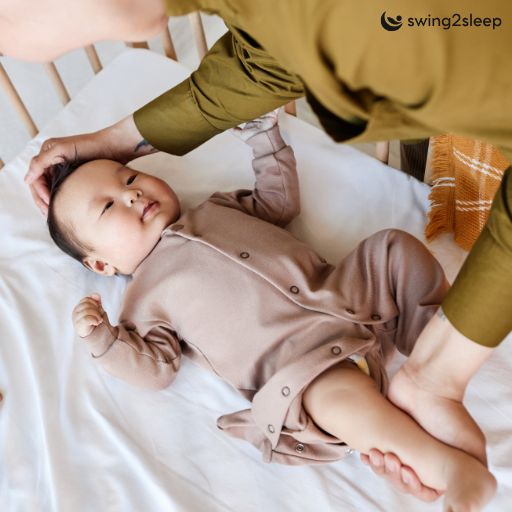
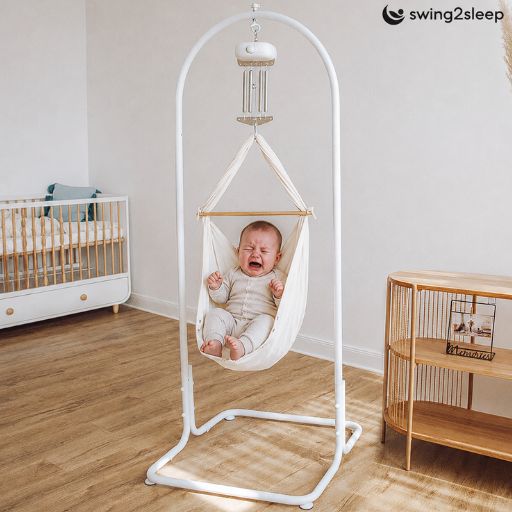
A calming and relaxing solution for sleep problems is the automatic baby hammock from swing2sleep. It gently rocks your baby to sleep and extends the so important deep sleep phases to start the next day well-rested.