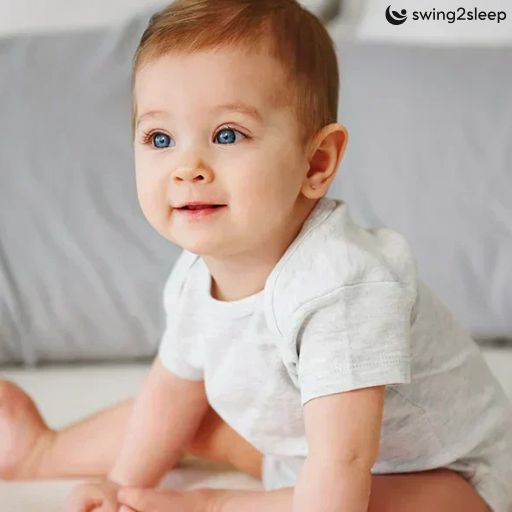


In the first months of life, babies cannot yet assume a sitting position and spend their time lying on their back or stomach. At around eight to nine months, most babies begin to slowly sit up. However, a lot of practice is needed before they can sit unaided.
We summarize when your baby goes through this important developmental step, how they can sit up on their own, and how you can support them in the process.
When does a baby start sitting?
After their baby has mostly been lying down since birth, many parents wait anxiously to see when their baby will sit up. When this milestone is reached depends on your baby's individual development. Generally, babies begin to slowly sit up at the age of eight to nine months.
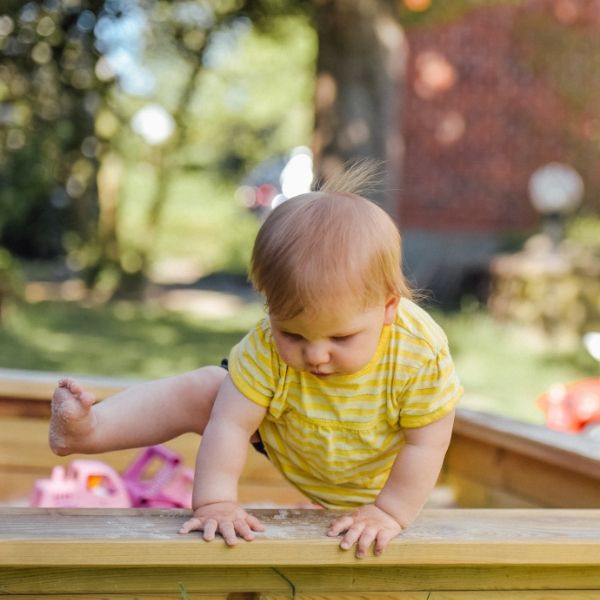
The first attempts at sitting can be bumpy, and your baby will certainly tip forward or to the side once or twice. Practice is required so that your baby develops their muscles and their sense of balance continues to form. After about one to two months of practice, your baby will have become so used to it that they can also sit alone.
This has the advantage that your baby can now view the world from a completely new perspective. Because in a stroller or in a carrier, they could see very little of their environment. When sitting, however, they participate much more in what is happening and can reach for objects better.
Learning to sit is an important milestone, but you should not put your baby under pressure. If they need a few weeks longer to sit up, then you should wait patiently. They will certainly begin to sit up soon. Every child develops individually – there is no reason for concern.
Important milestones in development
Are you wondering when your baby will sit alone? Before they can assume the sitting position, they must first go through further developmental steps. These build on each other and eventually enable your baby to sit up.
We summarize the most important requirements for sitting:
- Your baby lifts their head: After birth, your baby's head must be supported because their neck muscles cannot yet hold the head. Before your baby can sit, the muscles must be trained further. This usually happens in the prone position until your baby can hold their head independently.
- Your baby can turn over: In order for your baby to sit independently, the back muscles must also be trained. Have you already observed how your baby turns from their back to their stomach? In doing so, they train their muscles and prepare for sitting soon.
- Your baby practices sitting while lying down: When your baby lies on their back, they often stretch their legs up and hold onto their feet. What looks funny to you as parents is training for sitting. Because with this, your baby stretches their spine, which is a decisive factor in sitting.
- Your baby trains their muscles: Your baby's muscles must be trained so that they can sit. This happens, for example, through crawling and the first attempts at sitting. So do not expect your baby to be able to sit from one day to the next; rather, they go through a process.
So if you are wondering when babies sit, you should always take into account the individual pace of your little one. If they are already crawling diligently and turning over, they might soon make their first attempts at sitting. If they are taking their time, that is also perfectly fine.

How your baby sits up on their own
At the age of eight to nine months, your baby will not only learn to sit. In this context, they will also practice moving from crawling to sitting or getting up from a sitting position. All these exercises serve to strengthen your baby's muscles so that they can soon sit safely alone.
There are various ways your baby can assume the sitting position:
- Your baby lies on their side and supports themselves with their elbows to sit up.
- Alternatively, babies also push themselves off the floor with their forearms and slowly straighten up.
- After a few weeks, babies can also get into the sitting position from all fours.
For mom and dad, it is often a very special moment to observe their baby during their first attempts at sitting. Many babies test various positions and sometimes sit down quite by accident. Over time, they develop a feeling for it and will be able to sit much more securely after a few weeks.
When are babies allowed to sit?
You are probably wondering whether you should encourage your baby to sit up. Some parents sit their baby up at just a few months old so that they get to know the sitting position and soon sit up on their own. However, this is not a good idea.
Because after birth, your baby's spine is shaped like an arch. It is therefore rounded and thus not yet suitable for sitting upright. In addition, your baby's back muscles must first develop before they can make their first attempts at sitting.
If you sit your baby up too early, they cannot hold themselves. They will likely tip forward or to the side. They also remain in this still unnatural position because they cannot yet change their posture under their own power. You will therefore not promote your baby's development if you keep sitting them up.
Therefore, pediatricians and midwives recommend that babies should not be sat up as long as they cannot do so on their own. Wait patiently until your baby makes their first attempts at sitting – they will show you when they are ready.
When can babies sit in a high chair?
When your baby can sit in a high chair depends not only on their age but also on their development. Here, too, the recommendation is that you should only put your baby in a high chair when they can already sit alone.
If they cannot yet hold themselves alone and tip forward, then the right time for the high chair has not yet come. Until then, it is better to use a seat or bouncer in which the baby sits safely and which supports their spine.
If you want to sit your baby up and get them used to this position for a few moments, then it is better to sit them on your lap and support them well. This way, the spine is not strained and they cannot tip forward.
Sitting is a great effort for babies in the first months of life: So stay patient and wait for the baby's development. Sooner or later, they will straighten up all by themselves.
How can I support my baby while sitting?
As long as your baby does not sit up on their own, you should not encourage them to do so. However, there are some simple tips you can use to support your baby's motor development.
Movement is the most important thing. You should enable your baby to move freely. Let them kick and circle their arms in the air: Your baby trains their muscles and continues to develop. The more freedom of movement your baby has, the better and more naturally they can develop.
Therefore, keep placing them on a blanket and let them kick. Avoid tight clothing and let them crawl through the apartment in their diaper in summer: All this promotes natural development.
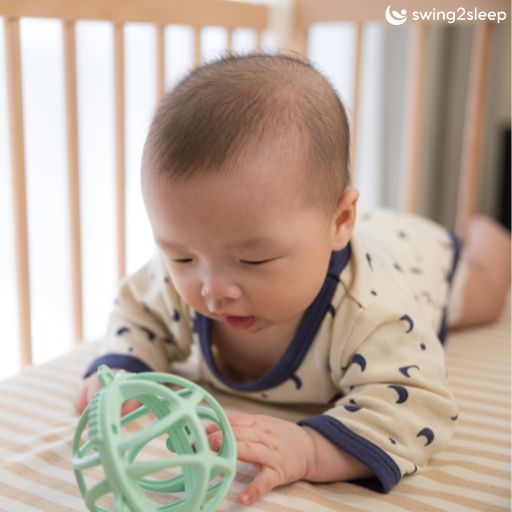
What can also be helpful is the prone position. As soon as your baby lies on their stomach, their muscles are strengthened. This makes the neck and back stronger, which in turn benefits your baby when sitting upright. Most children like the prone position anyway – but make sure to put your baby back on their back to sleep.

Automatic baby hammock from swing2sleep: Restful sleep for babies in development
For your baby, their first years of life are an exciting time: They are confronted with countless new impressions and continue to develop day by day. Therefore, it is not surprising that babies need so much sleep to process all the stimuli. If your baby is just starting to sit, you certainly know this.
If you want to offer your little one a cozy nest, then you should take a look at the automatic baby hammock from swing2sleep. Our proven sleep aid helps your baby find sleep more easily and sleep through better. This is ensured by the unique way the automatic baby hammock works.
You place your baby in the cozy hammock: There they are tightly enclosed as if in the womb and thus come to rest particularly well. Then the intelligent automatic baby hammock motor rocks them to sleep with gentle up and down movements. Even if your baby is currently going through a developmental leap, they can relax and fall asleep well in the automatic baby hammock.
Conveniently, you can control the automatic baby hammock motor easily via the app. You also receive push notifications if your baby wakes up or unusual movements are detected.
Our automatic baby hammock has already inspired over 192,000 parents: Convince yourselves of its unique functionality and support your baby in their restful sleep.
When can you sit a baby up?
A baby should be able to sit up under their own power before sitting regularly.
This is usually the case between the 6th and 8th month.
Sitting up early without their own stability strains the back and muscles.
When can a baby sit on your lap?
For short periods and well-supported, a baby may sit on your lap earlier.
It is important that the head and upper body are fully held.
Sitting should always remain an exception, not a permanent state.
Can I sit my baby up at 3 months?
At 3 months, the back muscles are not yet sufficiently developed.
Active sitting up should therefore be avoided.
It is better to give the baby freedom of movement in the supine or prone position.
When can a baby sit in a high chair?
A baby may sit in a high chair when they can sit independently.
This is usually around the start of complementary feeding.
A stable sitting posture is a prerequisite for safety and comfort.