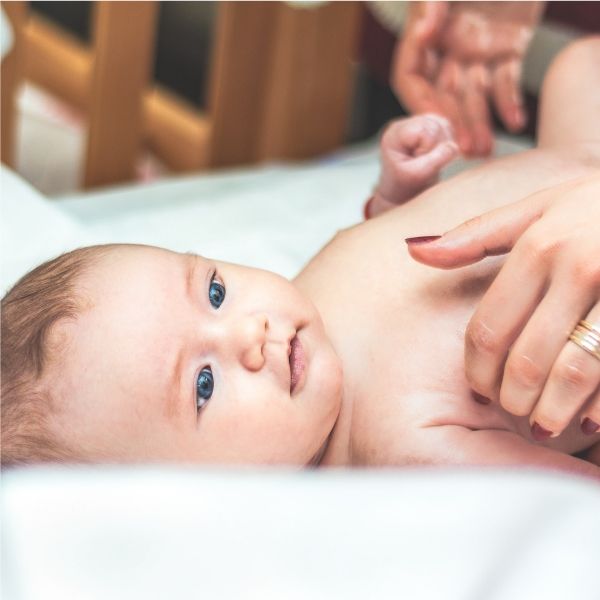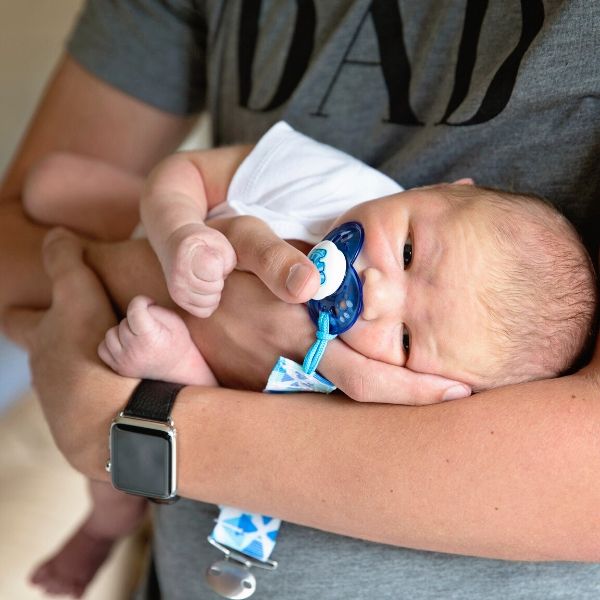



Your baby is here – pregnancy and birth are behind you and now you are experiencing baby's 1st month together. A wonderful time of cuddling and resting, of getting to know each other and bonding. You are now in the postpartum period and are gradually growing into your new roles together with your child. Many things may still feel unfamiliar at first, but also exciting and mostly beautiful. But what about your newborn's development in the first month of life? How much sleep is normal, how often should your baby be breastfed and which check-ups at the pediatrician are now due? We have summarized all the answers to these and other questions clearly for you in this article.

Baby's 1st month: Everything is new!
Just a moment ago, your child was protected and snuggled up in the warm womb – and now everything is different. The impressions of the world are raining down on your newborn. Loud noises and bright lights, cold temperatures, strange smells and unfamiliar clothing on delicate and sensitive baby skin. In addition, your baby's digestion is now starting to work, and there is an unfamiliar rumbling in the little tummy. All these impressions have to be processed, and your newborn does this by sleeping a lot.
Your baby's development at 1 month
But how does the little creature perceive the world around them? This varies from baby to baby. Some newborns react to visual impressions faster than others, some can already focus quickly with their eyes and still others discover the world with their sense of touch. Around the fifth week, the first big growth spurt is already due. Thus, the first weeks of your baby's life are characterized by all kinds of development.
The development of the sensory organs in the 1st month
- Vision: Your baby can already perceive differences in brightness and is also able to recognize faces at a distance of 20 centimeters. That's why it's advisable to get very close to your child's face when changing, bathing, carrying and cuddling. Soon your little one will look at you consciously for the first time with their eyes – a unique moment.
- Hearing: Your child already memorized the mother's voice in the womb. Just 12 hours after birth, they can distinguish your voices as parents from others. The sense of hearing of a 1-month-old baby reacts better to the human voice than to other sounds, which is why it is so meaningful to talk to your newborn.
- Smell and Taste: Immediately after birth, your baby has a functional sense of taste and smell, which develops rapidly within the first days of life. Your newborn will react to new smells, for example, by an increase in pulse and breathing rate or by moving their arms and legs.
Touch and motor skills in baby's 1st month
- Sense of touch: Newborn babies react to every touch and stroke, but are still particularly sensitive when it comes to overly strong expressions of love. If some touches are more intense, newborn babies can already perceive this as pain, although this sensitivity to pain decreases in the first weeks of life and your little one gradually becomes "more robust". Nevertheless: If the baby grows up with an older sibling, it is important to explain to the older child that they have to wait a little longer with boisterous cuddling sessions.
- Motor skills and reflexes: While the senses develop rapidly in the first weeks of the baby's life, motor skills still take a back seat in this phase. However, you will probably notice that your baby has a whole range of reflexes, such as the grasping reflex or the so-called Moro reflex. If your baby is startled, for example because they were put down, they jerk their arms and legs away, clench small fists and then jerk their limbs back together again. By the way: Between the third and fourth month, the Moro reflex disappears naturally; you can read more about this evolutionary remnant in our article “Early childhood reflexes: Everything you need to know about them”.
How much does your baby sleep in the 1st month?
Your newborn is particularly sleepy during the first two weeks of their life and has a high need for sleep to process impressions. As a rule, babies sleep between 14 and 18 hours per day in the 1st month. For some newborns, it may seem as if they sleep almost around the clock and even have to be woken up for breastfeeding or feeding. But of course, this varies from baby to baby. Some sleep significantly less than others and have longer waking phases; some naps last only thirty minutes, while others last two or even four hours. All newborn babies have one thing in common: they do not yet have a day-night rhythm and therefore wake up at irregular intervals at night to ask for a bottle or breast. This will change as they get older; most babies develop a regular sleep pattern starting from the second or third month of life. But don't worry: the day-night rhythm will settle in and your baby's sleep requirements will also be significantly reduced.

Building an emotional bond
The postpartum period is often referred to by many parents as "cuddle time" and for good reason: in the first weeks after birth, the main focus is on bonding, i.e., building the connection between you and your newborn. This begins in the hospital. Perhaps you had a spontaneous birth and your newborn could be placed directly onto your bare skin after delivery, but this skin-to-skin contact is also made possible in most maternity clinics in the case of a C-section. If the birth was difficult or if your little one still needs medical monitoring, the bonding experience can fortunately be caught up on. Intensive cuddling can help here just as much as a bonding bath, which you can perform together with the midwife.
The love hormone oxytocin
The hormone oxytocin plays a key role in building an emotional bond. Not only the mother who gave birth to the child, but both parents benefit from the release of the hormone. It is a powerful love hormone that secures the bond between parent and child. This is why direct skin contact is so important, as it promotes the release of oxytocin in you as parents just as much as in your baby. So use the time in the postpartum period to get to know each other intensively, smell the wonderful scent of soft baby skin, and cuddle extensively.
These things promote the bond between your baby and you:
- Breastfeeding or feeding, for example in the cradle hold and with eye contact.
- Skin contact, ideally on the bare chest or stomach of you parents.
- Carrying while humming or buzzing softly so that your baby gets used to your voice.
- Prompt reactions to your newborn's needs (hunger, thirst, closeness, etc.).
- Sleeping together in a safe (!) family bed.
Do you need to encourage a 1-month-old baby's development?
In the first month of life, your newborn is getting used to the loud, shrill world; that is enough stimulation for your little one for now. It is too early to support the development of your baby's skills through play. Instead, you can support their sense of balance and motor development by carrying your baby a lot. In a wrap or carrier, you have both hands free, while at the same time the baby is snuggled close to your body and you can do one thing or another on the side while the little one slumbers peacefully against your body. This way, they can always feel, smell, and see you and be sure that you are there.
Nutrition in the first month of life
The topic of baby nutrition is particularly important for many parents, as no one wants to make a mistake. Often, mother and newborn experience a few initial difficulties with breastfeeding, and bottle-feeding also doesn't always work right away. This is completely normal, however; many things simply require a bit of time and patience.
If you are having breastfeeding problems, our article "the 7 biggest breastfeeding problems" will certainly help you. Here you will find not only the problems you might encounter while breastfeeding, but also the corresponding solutions.
By the way: The vast majority of difficulties are caused by an incorrect breastfeeding position, which is why it is always advisable to seek help from a lactation consultant. They can support you in finding the perfect breastfeeding positions for you. Some babies prefer to be breastfed on their side while the mother is also lying down, while others prefer the cozy cradle hold and drink best that way.
Baby's 1st month: How often should you breastfeed or give a bottle?
Regardless of whether you choose breastfeeding or the bottle, it is important that you always take plenty of time to feed your newborn. Drinking is still exhausting for your baby at the beginning. This will level out as they get older and you will all become more practiced. Your newborn is very good at judging for themselves when they are hungry and when they are full. Experience shows that babies want to drink quite frequently in the first weeks of life - whether from the breast or the bottle. It is therefore perfectly okay if you feed your newborn on demand. It is best to look out for the following signs of hunger:
- Your little one turns their head back and forth.
- They lick their lips and stick out their tongue.
- They make sucking movements with their mouth or smacking sounds.
- They put their hand to their mouth.
Several wet diapers per day show that your baby is well supplied. If you are still unsure, you can always consult your midwife or lactation consultant or get in touch with your pediatrician.

Visiting the pediatrician and other health questions
In your child's life, there are ten mandatory early detection examinations at the pediatrician covered by health insurance – the so-called "U" examinations. They begin with the birth of your baby and are carried out until the age of 14 to medically check age-appropriate development. The U1, the very first examination of your child, takes place immediately after birth. Short tests are carried out by the midwife or the doctor before the newborn is quickly placed with the parents. For example, oxygen supply, breathing, heartbeat, and early childhood reflexes are checked. Congenital heart defects can also be ruled out during the U1. On the second or third day of life, a few drops of blood are also taken from the heel to check for metabolic defects.
The U2 is already carried out between the 3rd and 10th day of life – often still directly in the hospital. But you can also have the examination carried out outside the clinic if you have already found your pediatric practice. The following points are on the agenda for the U2:
- Examination of organs
- Senses
- Reflexes
- Documentation of weight
Baby's 1st month: The most important health questions
No question: Your baby's health is the most important thing in the world, and for critical questions, it is always advisable to consult your midwife or your pediatrician. However, we have compiled the most important tips regarding the health of your 1-month-old baby for you here:
What to do if my baby cannot be calmed down?
Your baby cannot be calmed down and seems to have seizure-like crying fits, even though they are otherwise thriving and healthy? It is quite possible that your 1-month-old baby has a regulation disorder, also colloquially known as three-month colic. The exact causes for this are unclear, but it is assumed that babies who feel like they are crying continuously, especially in the first few weeks, have not yet mastered the developmental step towards self-regulation. We know how nerve-wracking and exhausting this is for you, but we can reassure you that it is not a disease, but rather a condition. For most colicky babies, the crying fits subside at the beginning of the 4th month of life. For a few babies, this period of crying can last up to a year. Even if the crying usually has no serious medical cause, the constant crying can be very stressful for you as parents. A structured daily routine, fixed rituals, darkened rooms, sufficient daytime naps, lots of carrying, or a baby massage can provide a little relief. Many parents of colicky babies also swear by our automatic baby hammock swing2sleep. Your newborn is snugly protected in the hammock, and the gentle up-and-down movements ensure that they can calm down more quickly. We have summarized what else you can do for colicky babies in detail in this article.
How do I bathe my baby?
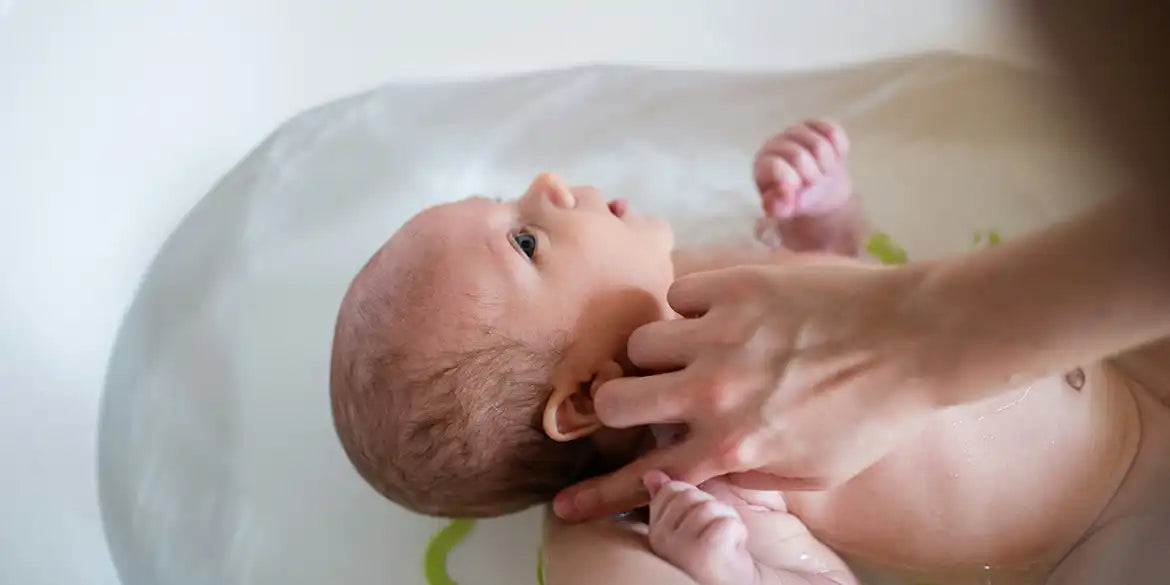
As soon as the umbilical cord has fallen off, you can bathe your newborn. But be careful: young baby skin is still particularly sensitive, which is why you should not let water touch it too often. In the beginning, it is enough to bathe your little one once or twice a week for about five minutes. For the correct water temperature of about 37 degrees, there are corresponding thermometers in drugstores that reliably show you the water temperature. To remove the smell of sour milk, which is quite normal in newborns, even without bathing, soft washcloths with warm water are particularly suitable. Make sure to clean the neck folds and also behind the ears and, above all, to dry them to avoid sore spots.
Small pimples on a 1-month-old baby
If your newborn has small skin blemishes or pimples on their otherwise delicate facial skin, this is no cause for concern and nothing unusual. After birth, the baby's hormones change and the sebaceous glands start working. As a result, small, pinhead-sized white nodules can appear, primarily in the forehead and neck region: these are called milia. It can happen that the sebaceous glands work too hard, then your baby might have pimples on their face - also known as newborn acne. Both phenomena are no cause for concern. Your child's skin first has to get used to the numerous environmental influences outside the protected womb. Please do not squeeze the pimples, as this only causes small injuries to the sensitive skin and the pustules can become inflamed. You should also avoid care products, as this usually worsens the problem. Just let a little time pass, as the small pimples usually disappear on their own.

You are doing great!
The first days and weeks with a newborn are exciting, exhausting, sleep-depriving, and nerve-wracking. Everything is new, not only for your little one but also for you, and of course, you don't want to do anything wrong for fear of harming your offspring. But rest assured: you are not alone and you are certainly doing a great job as new parents. Don't be afraid to ask friends or family members for help, use smart little helpers like our swing2sleep to give yourself a little rest, and above all, look forward to the time to come. Because your baby will have so many wonderful surprises in store for you that you won't stop being amazed. We hope we were able to give you a good overview of baby's 1st month and provide the security you need to relax and enjoy the cuddles.