

Even in the womb, your baby is optimally prepared for life after birth - thanks to early childhood reflexes. Did you know that? But not all early childhood reflexes remain with your baby. The Moro reflex, the tonic labyrinthine reflex, the list of early childhood reflexes is long and you have probably never heard of most of them.
Nevertheless, it is important to have an overview of the reflexes, because you can recognize your baby's maturation through them. In this article, we will tell you which reflexes are innate, which regress a few weeks or months after your child is born, and which early childhood reflexes continue to play a role into adulthood.
What are early childhood reflexes?
But first, let's get to the theory and the question: What actually are early childhood reflexes? In fact, this is a smart transformation of nature. The reflexes ensure that the infant is capable of surviving after delivery – even though the brain is still underdeveloped.
This is because babies can hardly do anything "consciously" or in a controlled manner in the first weeks of their lives. Early childhood reflexes are automatic reactions that regulate all vital tasks such as searching for food, food intake, but also self-protection, and thus ensure the survival of the infant.
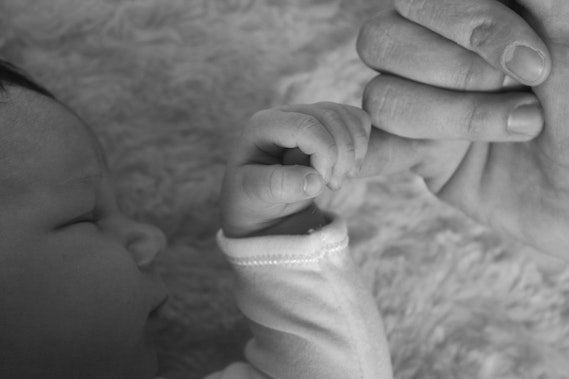
Perhaps you have already observed that your child tightly grasps your finger with their fist when you touch the inner surface of the hand? Or that your baby turns their head when you gently stroke their cheek? All of these are reflexes triggered by internal or external stimuli. The infant does not think about the movement behind it; they are innate movement patterns. They happen entirely without control and therefore always follow the same pattern.
Why do some early childhood reflexes diminish over time?
Some of the innate reflexes disappear again in the first months of life. Specifically, when the early developmental stages of childhood are passed through. They disappear because your child's brain becomes capable of making conscious decisions over time. In other words: from a certain point on, early childhood reflexes are simply no longer needed.
However, they are extremely important in your child's developmental process, because hearing, the sense of balance, visual perception, language, coordination, and fine motor skills develop from them. When the time comes, early childhood reflexes are replaced by coordinated movements. Some reflexes, however, remain for a lifetime, such as yawning or coughing.
In rare cases, it happens that early childhood reflexes do not fully regress in a child, and thus the child's independent development is not completely completed. Then there are residual muscle reactions of the respective reflex that continue to influence the child and the development of some skills later on. But that sounds worse than it actually is. We will tell you later in this article how you as a parent can deal with this and how you can support your child's development.
The most important early childhood reflexes you should know are:
The sucking-swallowing reflex
This reflex already develops in the 26th week of pregnancy. For example, your little one already sucks on their thumb, fingers, or even toes in the womb – you might even see this during an ultrasound examination. The sucking reflex ensures that the little human can suck on the breast or bottle after birth. The swallowing reflex, in turn, is responsible for ensuring that the food finds its way through the esophagus into the stomach. This makes these two early childhood reflexes some of the most important of all, because your child can take in food thanks to these reflexes.
The rooting reflex
If you place a healthy, newborn baby on its mother's belly, something amazing happens: the child moves independently towards the breast, sucks on it, and drinks as if it had never done anything else. This rooting reflex (in combination with the sucking and swallowing reflexes mentioned above) is responsible for the newborn searching for and finding the breast. To do this, it turns its head back and forth until it finds the food source it can suck on. You can trigger the reflex, for example, by stroking the baby's cheek. It then automatically turns its head in the direction the touch is coming from and may also open its mouth.
The grasping reflex
You have certainly observed this before: when you place a finger in your baby's hand, it is tightly grasped by the small hand. If you stroke the delicate sole of the foot, the foot curls up. This so-called grasping reflex is a relic from an earlier human era when infants still clung to their mother when she was in motion. The hand grasping reflex disappears at around the fourth month of your child's life, while the foot grasping reflex disappears after about eleven months.
The diving reflex
This is an important protective reflex for your little one: if water gets into your baby's nose or mouth, the airways close automatically – the water cannot get into the lungs. As a rule, however, this reflex disappears after a few months of life and is replaced by the cough reflex, which will accompany us throughout our lives. It clears the airways of foreign bodies and protects us automatically.
The Moro Reflex
Another remnant from our evolutionary past is the so-called Moro reflex. When your baby gets startled, for example because they are being put down, they lightning-fast extend their arms and legs and then pull them back together jerkily. In doing so, they clench their fists. This reflex once served to allow the newborn to quickly cling to the mother's body during sudden movements. For good reason, this behavior can still be observed in baby monkeys clinging to the mother's fur. The Moro reflex often ensures that your baby does not fall asleep as well in the first months of life or wakes up unintentionally in between. Here, swaddling can provide relief. We have summarized more on this topic for you in this article. By the way: The Moro reflex disappears between the third and fourth month.
The stepping reflex
This reflex often stays in one's memory after an examination at the pediatrician. During the U3 check-up, it is checked whether the stepping reflex is present – namely, by the doctor holding your little one under the armpits. As soon as the soles of the feet touch the surface, your baby automatically starts making walking movements, to "step". Just as if they were about to start walking. However, the stepping reflex has nothing to do with later learning to walk upright. Instead, the stepping reflex already makes itself felt in the womb as soon as your little one's sole of the foot hits the wall of the uterus. In addition, it is suspected that the stepping reflex plays a special role in assuming the correct birth position. The reflex disappears at about three months.

The crawling reflex
This is a preliminary stage of later crawling. It is triggered, for example, by placing your baby on their stomach and then pressing on the sole of the foot. Your little one then begins to crawl. The reflex trains your baby's muscles and promotes coordination. It is a clever training program from Mother Nature.
The tonic labyrinthine reflex
A somewhat more complex early childhood reflex to explain is the Tonic labyrinthine reflex. Here, a distinction is made between the Tonic labyrinthine reflex forwards and the Tonic labyrinthine reflex backwards. The TLR forwards already develops from the 12th week of pregnancy and enables your unborn baby to go into a fetal flexed posture. This allows it to make itself comfortable in your belly in a space-saving way. The TLR backwards is important for the birth and is only triggered by vaginal birth. After the child is born, the TLR backwards serves as a training program for the extensor muscles of the small body. It enables your baby to straighten up – against gravity. The tonic labyrinthine reflex has an influence on the entire muscle tone – i.e. the natural tension of the muscles – from the head downwards.
What if early childhood reflexes are still active?
In some children, it certainly happens that residual reactions of still active reflexes do not break down independently. If there are residual reactions even at a later point in the child's life, an otherwise mature child can react unusually sensitively to problems. For example, posture and motor skills can be restricted. Anxious behavior patterns as well as difficulties in learning grammatical structures and other reading and writing skills can also occur.
During examinations by the pediatrician, early childhood reflexes and their breakdown are usually checked. If you observe any of the things mentioned above in your child, it is advisable to speak with the pediatrician. If one or more early childhood reflexes are still active, you don't have to worry – just take action. With the help of so-called reflex integration, your child's development can be given a boost. Trained occupational therapists can perform reflex integration in several sessions. The therapy makes up for what did not take place during the child's independent development. Together, the residual muscle reactions of active early childhood reflexes are then broken down, so that possible gaps in development, learning or concentration problems, but also motor difficulties in your little one quickly become a thing of the past.
In short: Early childhood reflexes are decisive for the healthy development of your child at the right time. However, it is just as important that the reflexes are broken down again – so as not to "block" further developmental progress. But if residual reactions of early childhood reflexes are still active in your child and do not break down independently, this can be well treated with the right therapy – reflex integration.