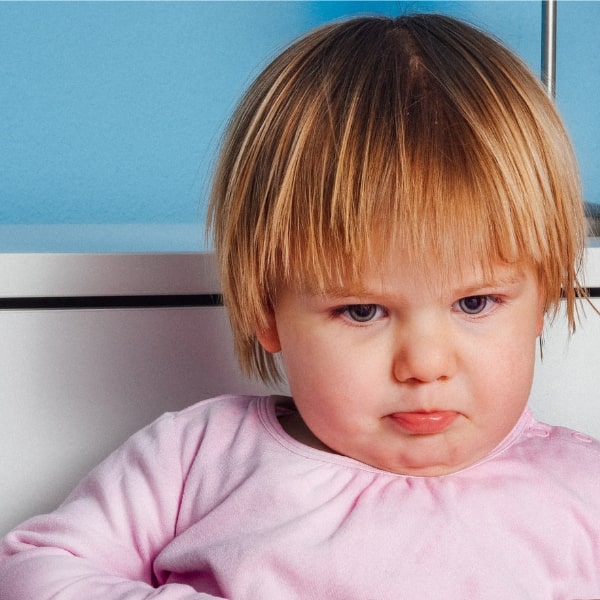


Many parents know this only too well: if things don't go exactly according to the child's nose, the nagging is huge. It can be enough to tie your child's shoe, even though he wanted to do it himself, or to cut the bread in the wrong place. And then there's not just protest - there are real dramas.
Emotional children - wilder, louder, more sensitive
A spilt juiceglass can lead to complete escalation . If the cap is scratchy, the curtain rises on a dramatic spectacle - complete with encore. What is wrong with these children? Is this kind of behavior still normal?
Perhaps the child is simply in the defiant phase. And then it just tries to get its own way and protests when it doesn't like something. And it's also normal that this can be quite exhausting and annoying at times. However, this child seems to lose all sense of proportion when he goes crazy.
In fact, the decisive factor is how often and how violent your child's tantrums are. If it's a constant rather than an exception, you can assume that you have a so-called "emotional child".
What is anemotionalchild?
Emotional children are different. Even as babies, they don't just cry quietly, but protest vehemently and loudly. If something doesn't go their way, they become obnoxious. This is very stressful for parents. It is now assumed that one in seven children exhibits strong emotional tendencies.
We now know that the amygdala, the alarm system in the brain, is particularly pronounced in affected children and therefore particularly sensitive. Even at low levels of stress, their brainswitches to the highest alarm level and thus into emergency mode, so to speak. Even a relatively trivial event such as a brokenzipper can be enough to trigger this.The subsequent tantrum then not only lasts a few minutes, but can easily last for a few hours .

How to recognize emotionally strong children?
Emotionally strong children experience and express their feelings exceptionally intensely. They quickly switch from one extreme to the next. This particular sensitivity can also easily lead to sensory overload .
When it comes to gettingsomething through, such children display remarkable tenacity and determination. However, this can also be interpreted as a lack of flexibility with regard to their wishes and goals. This is supported by the fact that these children are often very attached to familiar rituals and have great difficultydeviating from them . They find it difficult to accept changes and innovations. On the other hand, their energy and urge to move are almost inexhaustible. As a result, they usually get by on less sleep than their peers. It is not uncommon for these children to be more brooding and deal with deeper thoughts thantheir peers.
Emotionally strong children generally develop faster than other children. As babies, they turn early and, on average, learn to walk sooner. This is also due to their iron will and extreme determination.
These children simply experience everything much more intensely: music is not just loud, it makes your head explode. Washing theirhair is not just annoying, it's unbearable. The sting of a bee is not only unpleasant, it causes hellish pain. This extreme depth of sensation is also linked to the only weakly developed Sself-soothing ng competence .
This combination makes it particularly stressful for parents, especially as the needs of such children seem to be a bottomless pit.
Emotionallystrongchildren may be exhaustingfor those around them , but they arealso extremely creative and imaginative. They question rules and norms from an early age. On the one hand, this will not make it easy for them throughout their lives - but it has always been the questioners, the lateral thinkers, the uncomfortable, the nerds and the revolutionaries who have driven social progress.
In addition, persistence and determination can enable them to have an impressive career. Nothing and no one can stop them. As long as this does not take on psychopathic and empathy-less traits, it is a real gift with which these children can achieve great things.
What can parents do?
Raising an emotional child is certainly exhausting.
It is important that you are aware of the causes and background to your child's behavior and their character traits. Your child is neither a bad person nor maladjusted. In fact, many parents realize upon self-reflection that they themselvesused to be anemotional child.
Raising such a child certainly requires a special sensitivity, but with the right tricks, this can also be managed and the child's energy can be directed in the right direction.
Most of the rules for dealing with your child are basically very simple: when things get heated, keep calm, count to 10 and try not to get stressed. Provide balance during particularly critical phases. Various relaxationtherapiescan alsohelp your child to gradually understand and control their emotions better.
If parents know in advance what will lead to a tantrum, they should try to avoid such situationsfrom the outset. Sometimes this is possible, sometimes not.A little creativity is required here .
By the way,you won'tachieveanythingwith anemotional child by using force .
The same applies here: set boundaries!
However, even emotional childrendo not havea license to behave badly. If parents let them get away with everything out of consideration or out of fear of a tantrum , this would be a fatal strategy. Emotional childrenin particular must alsolearn toadhereto basic social norms . However, this is a balancing act: on the one hand, you have to show your child that you lovethem no matter how they behave . On the other hand, you have to make it clear to them that they cannot behave the way they want everywhere and at all times. This requires a very attentive, appreciative but also limit-setting upbringing.
These sensitive children in particular need firm boundaries and close emotional support from their parents. Their strong feelings sometimes make this a greater challenge than with other children - but the bond is also particularly intense.
Source: Imlau, Nora. 2018. so much joy,so much anger. 9th edition. Munich: Kösel-Verlag.