



All parents want their children to grow up healthy. The U-examinations are intended to ensure that possible illnesses or developmental disorders can be recognized quickly and treated in good time. There are 12 U-examinations that should be carried out at different stages of development. This article provides you with an overview.
The U-examinations: An overview of preventive check-ups for children
Preventive check-ups for children are intended to ensure the healthy mental and physical development of children. In addition to special screening tests for certain diseases, physical examinations of the child are also carried out. They usually also include counseling for parents. Children make enormous developmental steps, especially in the first years of life. That is why the scheduled time windows for the early examinations are still relatively closely timed, while the periods become longer as the child gets older.
If your child shows abnormalities in the course of these examinations, they will be supported and encouraged in a targeted manner. Although it is not yet possible today to cure all congenital diseases through preventive check-ups and early treatment, in the vast majority of cases, at least serious consequences for the child's development can be avoided or alleviated. In the following, you will receive an overview of what is tested during the individual U-examinations, what the treating pediatrician pays particular attention to, and in which time windows the individual examinations are scheduled.
Why take the child for a U-examination?
The U-examinations serve the timely detection of serious illnesses or developmental delays in order to be able to intervene early if necessary. In the course of childhood, 12 examinations are planned (including the subsequently introduced U7a). This means that your child should be examined at certain dates until the age of ten, because the early detection of some diseases and promising treatment is only possible within a certain period of time.
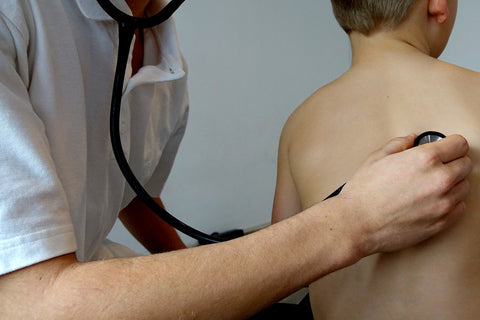
The preventive appointments are set so that the treating pediatrician can assess important developmental steps of the child. Conspicuous behavior or a developmental delay often only appears relatively late in toddlerhood and not immediately in the first year of life. A good example is language development. If an impairment of language development is recognized early, it can be successfully counteracted through timely targeted support.
Many developmental steps build on each other. Therefore, an unrecognized disorder can suddenly have cascading consequences and affect the entire development of your child.
After the birth of your child, you received the child examination booklet, which is also called the "Yellow Booklet". It contains more detailed information on the individual examinations as well as a removable participation card. With this card, legal guardians can document the examinations to kindergartens or other institutions without giving out detailed information.
Nowadays, preventive check-ups place a stronger focus on the parent-child relationship. In addition, counseling on vaccination protection is now a mandatory component, as is cystic fibrosis screening for newborns.
Are the U-examinations voluntary or mandatory?
Health examinations for children and adolescents are defined as benefits of the statutory health insurance in § 26 SGB V. Since 2009, U-examinations (U1 to U9) have only been mandatory in some federal states. Where they are not mandatory, a parent receives a written invitation to the U-examination. However, if you do not react to it, the office will be informed and you will receive an official letter. This is not only unpleasant but also annoying. The reminder letter also includes requirements that you should take care of immediately.
In addition, the crèche or kindergarten may later require proof of the U-examinations. This is to ensure that you have provided appropriate vaccination protection. Furthermore, the U-examinations serve not only to detect and treat illnesses – cases of neglect or child abuse can also be quickly uncovered in this way.
Are the U-examinations free of charge or subject to a fee?
The U-examinations are covered by the health insurance companies, provided you keep the appointments without gaps. If an appointment is missed or your child is registered too late for a U-examination, there is a risk that the health insurance company will want to leave you with the costs. This can be annoying and expensive, even if you manage to push through the cost coverage after all. Therefore, it is advisable to arrange the appointment with the pediatrician in good time, especially since appointments in many pediatric practices are already fully booked weeks in advance nowadays.
In addition to the legally defined examinations of the U-examination program, a number of health insurance companies offer additional examinations, especially for children of primary school age (U10 and U11) and for adolescents (J2). The content of these examinations is not bindingly prescribed. Nevertheless, the costs are covered by individual health insurance companies as a voluntary benefit. It is best to ask your health insurance company about this.
U-examinations at a glance
The first U-examination, "U1", takes place immediately after the birth of your child. You will also be handed the "Yellow Booklet". In this preventive booklet, the treating doctors document all results and findings of the individual early detection examinations. In this way, they and all other treating doctors always keep an overview of the development to date. You should have the booklet with you at every doctor's appointment. In addition, the booklet provides you with a good overview of the time periods for the various U-examinations. This way you can take care of the corresponding appointments in good time (ideally 3–4 months in advance).

Focus of the individual U-examinations
The "Yellow Booklet" also informs you about the contents of the individual examinations. The individual physical examinations are always tailored to the age of the child. They always consist of a check of weight, body length, and age-appropriate development. In addition, there is the examination of individual organs, the head, and the musculoskeletal system.
During the developmental assessment, the doctor examines, among other things, gross and fine motor skills, the child's social and emotional competence, and the child's interaction with the parents.
Depending on the developmental period, you will receive additional advice, e.g., on vaccination protection, nutrition, accident prevention, dental health, or sudden infant death syndrome. Of course, you can also address questions or concerns about the respective U-examination in this context. Your treating pediatrician will provide you with comprehensive answers.
By the way
Did you know that you can specifically influence your baby's development? Rocking works wonders – whether in your arms, on a Pezzi ball, or in our automatic baby hammock from swing2sleep. It promotes the sense of balance and thus the motor development of the child. The stimuli generated during rocking are transmitted via the baby's inner ear to the brain, where the cells continue to network (see vestibular system). As a result, the brain is stimulated and becomes more efficient.
Rocking is fun and good for our brain.