

The foundations for life are laid in earliest childhood. It is now common knowledge what devastating effects early childhood trauma can have well into adulthood. A key factor is basic trust. An infant is at the mercy of its parents in the first years of life and is existentially dependent on them. If they feel abandoned or left alone, this can persist throughout their entire later life. A healthy parent-child bond that provides emotional security is the basis for healthy psychological development. How much an adult can trust people and engage in healthy relationships depends on whether they were allowed to experience basic trust as a child. In the following article, we explain the effects of a lack of basic trust and how your child develops basic trust.
Basic trust: The stable foundation of self-confidence and resilience
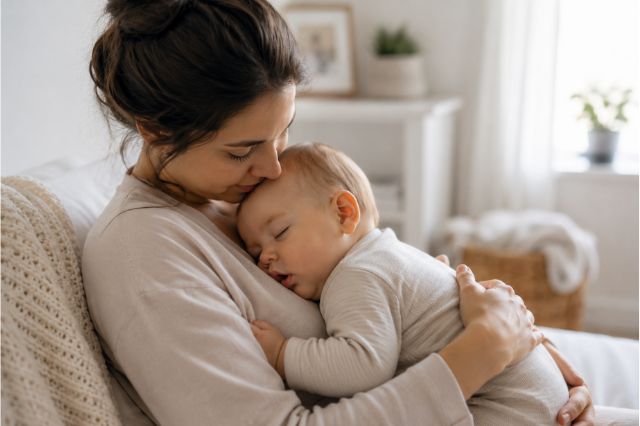
If you let your baby cry, it can eventually have a lasting impact on their basic trust – and stable basic trust plays a decisive role in a person's later life, self-confidence, and self-esteem. If basic trust is missing, the affected person will always be suspicious of everyone. An affected child will find it difficult to trust other people. How could it be otherwise, when those affected already had to experience as a baby that the most important people in their life, their own parents or close caregivers, do not look after their child, are not reliable and are not there in the first months of life when they are needed most? Strengthening basic trust is therefore particularly important for a baby. Basic trust is an important pillar for learning self-soothing skills. The baby must also learn and experience that parents and caregivers continuously look after a child lovingly and provide them with inner emotional security. Only then do they experience that there are people they can rely on completely when they are feeling bad. A wonderful experience for every person, whether young or old.

When is basic trust actually disrupted?
Basic trust is disrupted when the child is permanently treated unkindly by their caregivers and thus does not feel secure. Or when they feel that their distress is a matter of indifference to the parents – when they feel left alone or abandoned. Even if caregivers mistreat a child, neglect them, and reject the child emotionally, this will change their further development and ability to trust. But apart from abuse and neglect, can basic trust already be damaged if you raise your voice at the child? The topic of basic feelings also leads to uncertainty on the part of parents. Does this mean that you have to anticipate your baby's every wish? Does this mean that for fear of offending the child, you can never set boundaries? Do parents always have to run to the child as soon as they fuss a little? That cannot be the conclusion. Everything has limits. No mother can or should always let her baby get away with everything out of fear that their basic trust will suffer.
Reliability creates resilience
If, for example, a approx. 6-month-old baby simply won't sleep at night. Nothing helps, the child is hyperactive and would much rather play. The mother eventually loses patience and says in a rather harsh tone that it is finally time to sleep. This event certainly won't immediately cause basic trust to suffer. The child will not understand the words, but will sense from the tone of voice that Mom is serious now. It would be different if the mother were to scream at her child or perhaps even shake them.
Just raising your voice is normal and part of interpersonal non-verbal communication. The child hears from the tone of voice that a limit has now been reached. The experience that others reveal their different moods through their pitch is part of early childhood learning. It is completely normal that we sometimes talk to each other in an excited, impatient, or upset manner. It is part of life. It is just as normal if the child then reacts accordingly with crying or fear. As long as the maternal reaction remains within reasonable bounds, everything is fine. In addition, a 6-month-old child can already understand more than a newborn. But even with a newborn, trust will not be immediately compromised if Mom raises her voice.
Lack of basic trust through withdrawal of love
It is much more important that the child is never punished with a withdrawal of love – no matter what is going on and what they have done. The child must feel that Mom and Dad always still love them, even if they cry a lot, are stressful, are high-need or did not behave as desired in that moment. In a family, different needs collide and especially within the first months of life, when a child is born, family members first have to find each other and grow together as a family. Trust develops, but basic trust is already formed in the womb and is innate. Accordingly, a toddler should never have the feeling of being a burden to the well-being or mood of a caregiver.

The child must be loved, and without limits, along with all their rough edges and along with their strengths and weaknesses. This also means that parents always treat their child with respect and benevolence. The fact that they might still raise their voice every now and then or clearly state when something doesn't suit them is not excluded by this. On the contrary, it can support development, because experiencing that other people have boundaries and stand up for them leads to a stable social attitude and development of the child.
Our automatic baby hammock: Positive experiences and security like in the womb
Especially with excessively crying infants, overwhelmed parents often reach their mental and physical limits. The result: frustration, helplessness, feelings of guilt, and fear of failure. Some parents react in such an extreme situation with withdrawal or anger. Especially in the first months of life, alienation develops between parent and child, and the bonding and development of basic trust is significantly disturbed. It is important to be less stressed in order to be able to give the child exactly what it needs in that moment.
An automatic baby hammock from swing2sleep helps you break the downward spiral of tension, anger, and even despair, and acutely allows more relaxation, joy, and life energy to return to your daily life with the baby. Thanks to the gentle up-and-down movements and the cozy snugness, your child feels as secure as in Mom's belly and can come to rest. And you, too, finally have a little time for yourselves again, without exposing your child to a separation that would be emotionally distressing. The stress fades away, and you can spend the so important first period with your offspring lovingly and harmoniously together.
If you are unsure whether the concept suits you and your child, you can gain positive experiences by renting the swing2sleep for one month. Because trust based on experience is at least as important to us as your child.