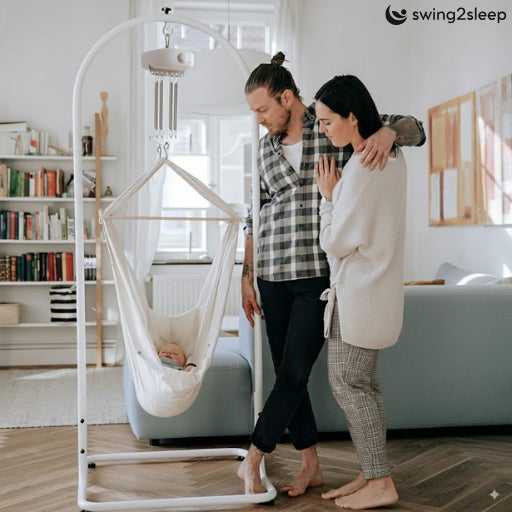
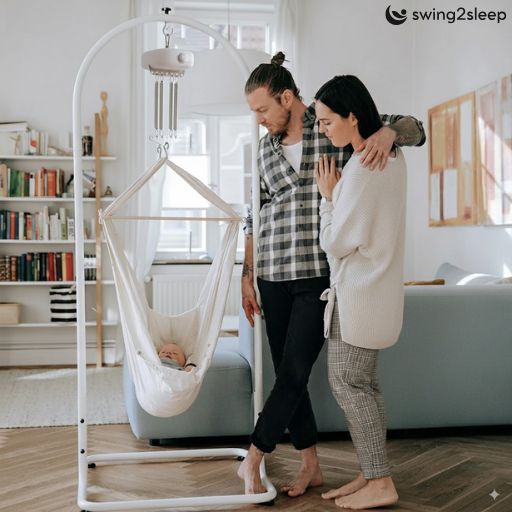


The question of how babies should lie in the first months of life concerns many parents. Particularly often, it is about the back and the spine: Should a baby lie as straight as possible or is a slight curve even healthier? Baby hammocks and automatic baby hammocks are often at the center of the discussion in this context.
In order to be able to answer this question soundly, it is worth first taking a look at the natural development of the baby's spine. Because only those who understand how the baby's back develops from birth can assess which forms of support make sense and which do not.
Development of the spine in babies
The spine of a baby is in a sensitive development phase in the first months of life. It is not yet designed to carry weight or stabilize an upright posture.
Instead, it develops step by step through movement, maturation of the muscles and changing positions in everyday life. To be able to judge which support is useful during this time, it helps to understand the natural anatomical conditions of the baby's back.
The natural shape of the spine after birth
The spine of a baby differs fundamentally from that of an adult. Directly after birth, it is still evenly rounded and forms a so-called C-shape.
This curvature is not a sign of weakness or poor posture, but the result of the long time in the fetal position in the womb. There, space was limited, the back gently rounded and optimally protected.
The vertebral bodies and intervertebral discs of a newborn are also still very soft and elastic. They consist largely of cartilage and are designed to adapt to movement and stress. This is exactly why the spine needs one thing above all in the first months of life: support instead of correction.
From the C-shape to the double-S-shape
The typical double-S-shape of the human spine only develops over time. It does not arise through early sitting or positioning that is as straight as possible, but through active developmental steps of the child.
When babies begin to lift their heads, turn, later crawl and finally walk, the spine and muscles adapt step by step to the new requirements.
Each of these developmental phases strengthens different muscle areas and supports the natural straightening of the back to develop gradually on its own. If this development is influenced too early by stretching or fixed specifications, this can even hinder the process, as the stabilizing muscles are not yet sufficiently mature at this point.
Why a rounded baby back is healthy
A rounded back in infancy is therefore not only normal, but an important part of healthy development. The spine is evenly loaded, the intervertebral discs are protected and the pressure on individual areas is minimized. Only with increasing muscle strength and motor maturity does the posture change naturally.
The decisive factor in this phase is not that the back lies as straight as possible, but that it is well supported and can develop freely. This is exactly where the understanding of modern, ergonomic support comes in: It is based on the natural shape of the spine and not on the posture of an adult.

Baby hammock & automatic baby hammock: Support for the spine
Especially in the first months of life, many parents look for ways to gently support their baby and at the same time provide relief. Baby hammocks and automatic baby hammocks address exactly this early developmental phase.
Their goal is not to actively shape the back, but to accommodate and accompany the baby's natural posture. The decisive factor is how well the respective aid adapts to the anatomical needs of the child's spine.
How a baby hammock relieves the baby's back
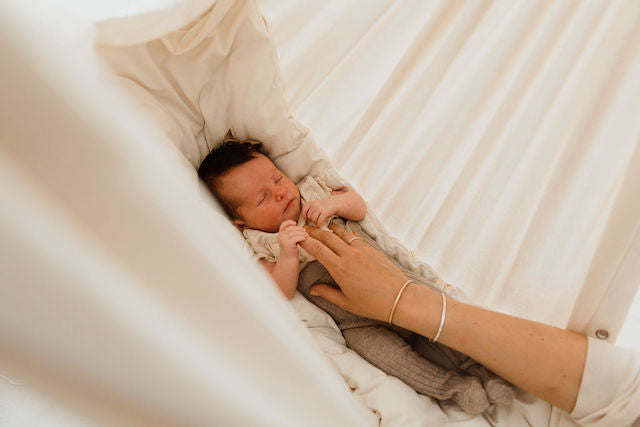
A baby hammock adapts to the natural curvature of the spine instead of stretching or fixing it. The back lies softly embedded and can maintain its rounded shape, as is typical for newborns. This adaptability clearly distinguishes the hammock from rigid lying surfaces.
Another important aspect is the even weight distribution. In a baby hammock, the baby's body weight is supported over a large area. This prevents localized pressure points, for example in the area of the head, pelvis or lower back.
The back is relieved without being forced into an unnatural position. Especially for babies who need a lot of closeness and gentle boundaries, this can be perceived as very pleasant.
Automatic baby hammock as a gentle further development
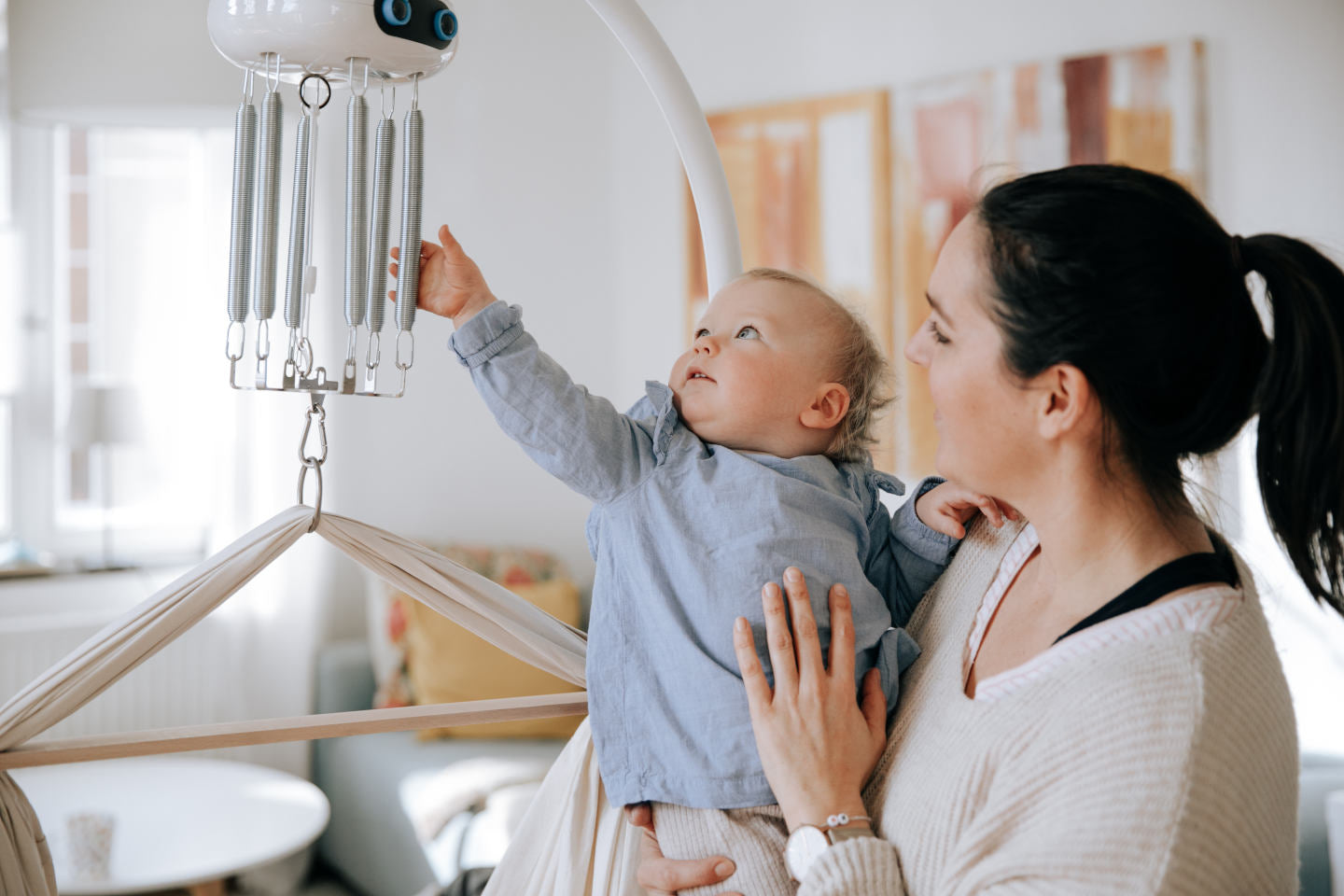
An automatic baby hammock builds on the principle of the baby hammock and complements it with a gentle swinging motion. This movement is reminiscent of the time in the womb, in which the baby was constantly in slight motion due to the mother's movements. Many babies find this rhythmic rocking soothing and relaxing.
For the back, the swinging motion does not mean additional strain, but rather relief. Due to the even swinging, the pressure continues to be distributed harmoniously over the entire back.
At the same time, the muscles and nervous system can relax, which indirectly also contributes to a healthy posture. It remains important that the automatic baby hammock is correctly adjusted and the baby lies well supported.
Distinction from baby bouncers and car seats
In contrast, baby bouncers and car seats often force a sitting or semi-sitting position for which a baby's back is not yet designed.
The back is often compressed, the pelvis tilts backward, and the weight rests selectively on the tailbone and lumbar spine. The stabilizing muscles are not yet sufficiently developed at this age to compensate for this posture.
For this reason, baby bouncers and car seats should only be used for a limited time and according to their actual purpose. While they are indispensable for transport in the car, they are not suitable as a permanent place to stay or rest.
Baby hammocks and automatic baby hammocks offer a significantly more spine-friendly alternative here, as long as they are consciously and diversely integrated into everyday life.
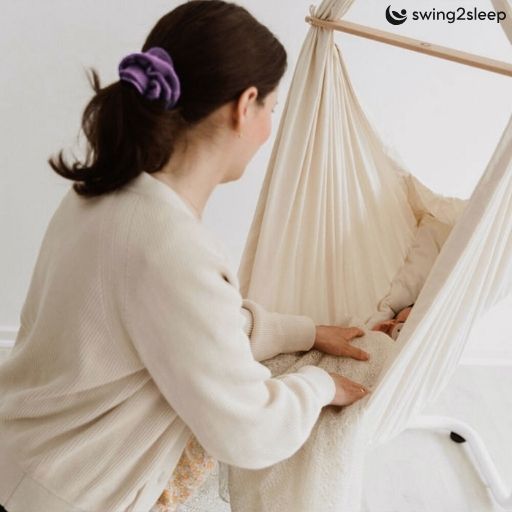
In this short video, you will learn how to correctly place your baby in our swing2sleep automatic baby hammock.
How to support your baby's spine in everyday life
The healthy development of the spine depends less on individual products and more on the daily handling of the baby. The decisive factor is a balanced change between different positions and forms of movement. It is precisely this variety that gives the spine the impulses it needs for natural development.
A variety of lying, carrying, and movement
No aid, regardless of how well-thought-out its shape is, should be used for long periods of time. An infant's back needs regularly changing impulses. Sometimes the child lies down, sometimes they are carried, and sometimes they can move freely. This variety prevents one-sided strain and promotes the development of stabilizing muscles.
Changes in position are particularly important. They ensure that different muscle groups are activated and that the spine can develop evenly. Short rest phases in a baby hammock or automatic baby hammock can be sensibly combined with time on the play mat or in your arms. This creates a natural rhythm of relief and activity.
Carrying in an ergonomic posture
Correct carrying can even positively support spinal development. In an ergonomic carrier or a correctly tied wrap, the baby automatically assumes the so-called spread-squat position.
In this position, the back is slightly rounded, the pelvis is tilted, and the spine is in a position that corresponds to its natural shape. From an evolutionary biology perspective, this is no coincidence, as babies are carried young and are designed from birth to be carried on the body of a caregiver.
Contrary to earlier assumptions, carrying does not have a negative effect on a child's back; rather, it can meaningfully support physical development. Many experts today agree that this posture positively influences both the spine and the maturation of the hips.
The prerequisite is that the baby wrap is correctly adjusted and the baby is well supported without stretching or compressing the back.
Tummy time and free movement
Another central factor for healthy physical development is regular tummy time while awake. In this position, the child actively works against gravity. This strengthens the neck, trunk, and back muscles, which later play an important role in sitting, crawling, and walking.
Free movement on a safe surface also gives the child the opportunity to discover their own body. Turning, kicking, and pushing up are natural development processes that optimally prepare the back. The more space a baby gets for this self-movement, the better their musculoskeletal system can adapt and strengthen.
Conclusion
A baby's spine is designed for development from birth, not for early correction. A slight rounding of the back is normal in the first months of life and important for the healthy maturation of the spine, muscles, and intervertebral discs. It is crucial to respect this natural posture and not to overtax it with rigid or sitting positions.
Baby hammocks and automatic baby hammocks can be a useful support if they adapt to the natural curvature of the baby's back and are used consciously. However, they do not replace movement but complement everyday life where relief and rest are required.
Changes in position, free movement, and ergonomic carrying remain equally important, as only the interplay of different stimuli enables healthy development.
Parents do not have to act perfectly, but attentively. Those who perceive their baby's needs, create variety, and ensure age-appropriate support lay a stable foundation for healthy spinal development, without any pressure, but with a lot of trust in the child's natural abilities.
These other posts might be interesting for you: