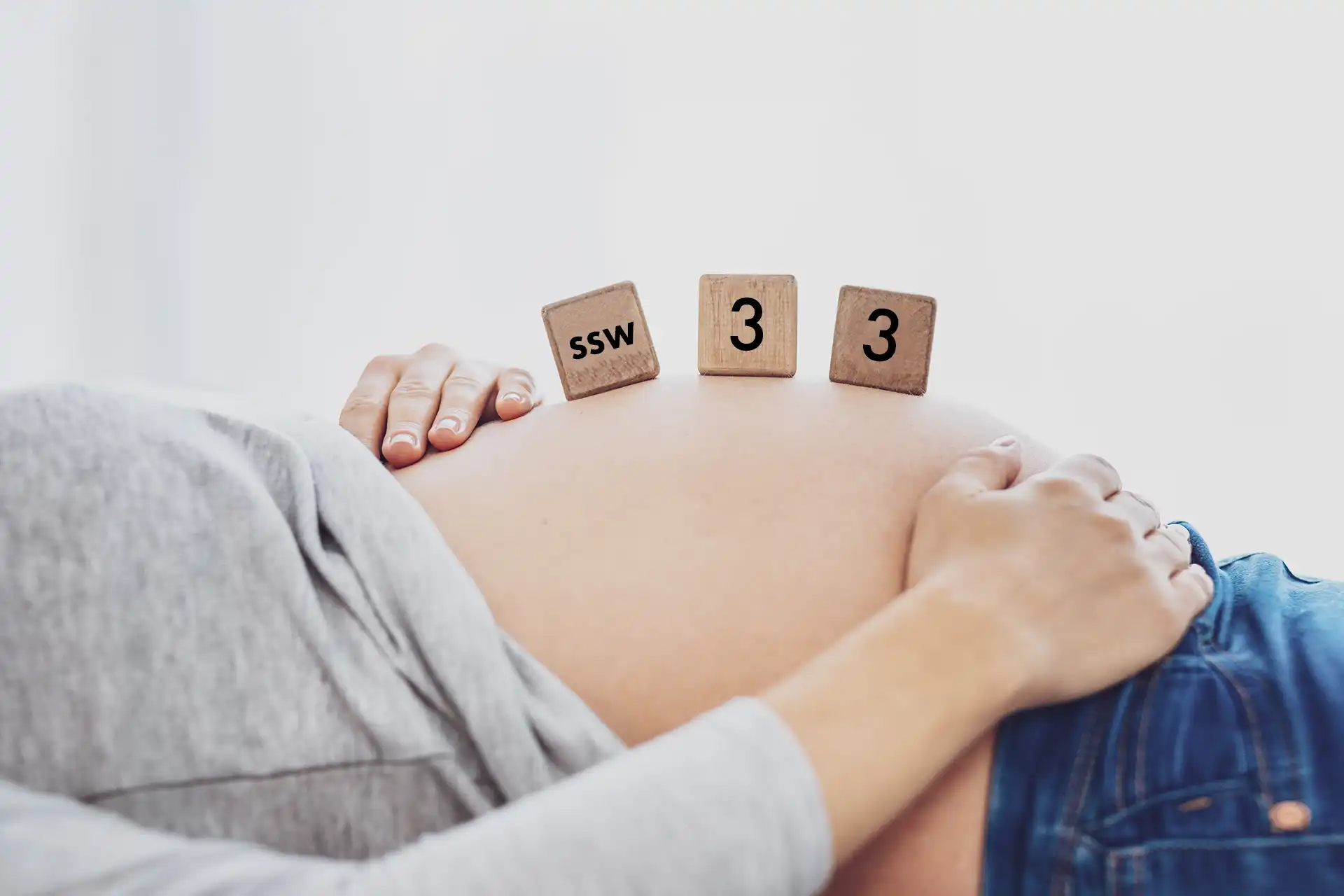


In week 33, the ninth month of your pregnancy begins for you. There are now about seven weeks left until the calculated due date and your baby continues to grow happily. Your belly is probably restricting you by now and you need help in everyday life.
In our pregnancy calendar, you will find out how your baby develops this week and how size and weight change. We also summarize for you how expectant moms are doing in week 33 and which symptoms are typical. We also introduce you to our innovative automatic baby hammock and explain how it helps your baby fall asleep.
Development of your baby in the 33rd week of your pregnancy
You are now nine months pregnant and surely notice that your belly is getting significantly larger now. This is because your baby is growing and developing further. Your baby's brain is growing and its head circumference is also increasing a little. In week 33, your baby will slowly lie with its head down. It turns and thus brings itself into its birth position – the cephalic position.
Initial engagement contractions ensure that your baby slips deeper into your pelvis. In the coming weeks of pregnancy, it will already lie so deep in your pelvis that it can no longer move into another position.
In the 33rd week of your pregnancy, your baby's senses are already highly developed. Through its eyes and ears, it perceives what is happening outside your belly. It can also already touch and consciously feel its feet and hands. Your baby can even taste already. For a few weeks now, it has been swallowing amniotic fluid to train its digestion.
However, your baby cannot smell yet. This sense will only develop after birth. There is no air in the uterus, so your baby cannot smell anything.
Size & weight in the 33rd week of pregnancy
In the last weeks of pregnancy before birth, weight gain is the main focus for your baby. It now has a weight of 1,900 to 1,950 grams. The size is 43 to 45 centimeters, but can vary a little from baby to baby. Your baby is now as big as a papaya – elongated and with a larger circumference.
Currently, it is gaining 200 grams per week and will soon reach the milestone of 2 kilograms. Many pregnant women notice in this phase that the additional weight of the baby in their body is becoming an increasing burden. Therefore, treat yourself to enough rest and breaks.
You can use these for the final preparations. Surely you want to offer your baby a cozy nest after birth in which it can sleep restfully. For this, we recommend the automatic baby hammock from swing2sleep. Your baby can sleep undisturbed in the hammock and is protected from light and movement. The light up and down movements make falling asleep much easier and promote staying asleep.
Initial engagement contractions & fatigue: How you are doing in week 33
You are now in the 9th month of pregnancy and will probably feel exhausted by the pregnancy. Many expectant moms report that they are significantly more tired from week 33 onwards and can move less well due to the growing belly. If you now need support putting on your shoes and carrying your shopping, you should definitely ask for help. Your body is doing great things and should be relieved as much as possible.
In the 33rd week of pregnancy, you may feel your first practice contractions and engagement contractions. These occur irregularly and do not increase in intensity. As an expectant mom in week 33, you perceive these as a slight pulling sensation that can also radiate into the back and legs.
Symptoms & complaints in pregnancy week 33
In week 33, you are considered heavily pregnant: there are about seven weeks left until delivery. The progression of your pregnancy can be associated with new symptoms and complaints.
Many pregnant women are short of breath in the 33rd week of pregnancy. Your baby is pressing on your organs and on your lungs. In addition, pregnancy hormones can cause fluid to accumulate in your lungs. This leads to you being short of breath and no longer being able to take a real deep breath. A few weeks before birth, however, your belly will lower and your baby will slip even deeper into the pelvis. Many women can then breathe better again.
You are probably also struggling with swollen limbs. These are caused by water retention in the legs, feet, arms, and hands. Especially in summer, these represent an enormous burden for pregnant women. It is also possible that you develop carpal tunnel syndrome caused by your swollen hands.
Your baby is now a considerable size and exerts pressure not only on your organs but also on your bladder. You probably suffer from frequent urination. Some pregnant women also tend towards slight incontinence caused by the pressure.
Another typical complaint in the 33rd week of pregnancy is severe itching on the belly. Your skin and tissue continue to expand. With a nourishing oil, you can prevent both itching and stretch marks. Growths on the gums and leaking pre-milk (colostrum) are also not uncommon in week 33.
In about seven weeks, you will hold your baby in your arms. If you want to have everything prepared by then, you should take a look at the automatic baby hammock from swing2sleep now. Its silent motor rocks your baby to sleep and adapts to its movements thanks to an intelligent sensor. You can easily control the practical cradle via an app and receive push notifications from it.
How do I recognize labor contractions?
In week 33, you already feel different types of contractions. This is no cause for concern and even quite normal. Your body is practicing for the upcoming birth.
The decisive factor is what type of contractions they are. We introduce you to the most important types:

Practice contractions:
Practice contractions occur from week 25 onwards. Your body is practicing for the birth. You recognize practice contractions by the fact that your belly becomes hard for a short time. Practice contractions are usually only slightly painful and may not even be perceived by you as contractions.

Preterm contractions:
Preterm contractions are premature contractions that could initiate a premature birth. These occur before the 36th week of pregnancy and thus still clearly too early. They are often triggered by stress or excessive exertion. Preterm contractions show you that you should take it easy and look after yourself more.

Engagement contractions:
Engagement contractions occur from approximately the 36th week of pregnancy. They ensure that your baby's head slips deeper into the pelvis. They are stronger than practice contractions and can therefore give you a little fright at first. However, engagement contractions are no cause for concern.

Dilation contractions:
Birth begins with dilation contractions. They are significantly stronger than engagement contractions and open your cervix. Dilation contractions usually last between 40 and 45 seconds and occur at regular intervals. Once the cervix is open, expulsion contractions and pushing contractions follow.

Afterpains:
After birth, the contractions are not over yet. The subsequent afterpains ensure that your body can expel the afterbirth and the placenta. They also serve to contract your uterus again and stop the bleeding.
Especially in the first pregnancy, it can be difficult for you to distinguish the individual contractions from each other. If the pain becomes intense in week 33, you should have it medically clarified what type of contractions they are. Your doctor can perform a CTG and thus measure your contraction activity.
Automatic baby hammock from swing2sleep: Intuitive reaction to your baby's movements
The automatic baby hammock from swing2sleep has been developed by us for over 23 years: it has already inspired more than 170,000 parents and is even recommended by midwives and osteopaths. This is because it serves as a sleep aid for your baby and also promotes staying asleep.
You place your baby in the safe hammock – there it lies tightly embraced, just like in the womb. In light up and down movements, the cradle ensures relaxation and thus helps your baby find sleep. The intensity of the movements is adapted to your baby. If it wakes up and moves, the intelligent motion sensors recognize this and rock your baby back to sleep.
Conveniently, you can control the silent automatic baby hammock motor via an app. This also sends you push notifications and informs you when your baby wakes up. If you want to offer your baby a cozy nest in which it feels particularly secure, the automatic baby hammock from swing2sleep is an ideal choice.