

Even during pregnancy, babies get hiccups every now and then, making their pregnant mothers' entire abdominal wall wiggle. And it is also somehow sweet when hiccups in babies become noticeable so early on!
Hiccups occur as early as the 22nd week of pregnancy . They are caused by sudden spasms of the diaphragm, which are usually harmless and soon pass.
Even after birth, hiccups occur repeatedly in infants. What many people don't know: hiccups have an important function. There is no cause for concern.
The baby has hiccups: What to do?
Hiccups are caused by irritation of the diaphragmatic nerve (phrenic nerve).
Triggers can be various things: swallowing too hastily, very hot or very cold food or drinks, carbonated drinks, or spicy food. If the diaphragm cramps as a result, the glottis between the vocal cords closes.
Some assume that hiccups have a protective function: the brief closure prevents food from entering the windpipe. When inhaled air hits this barrier, what we know as hiccups occurs.
How do hiccups feel for babies?
Many parents wonder if hiccups are unpleasant or even painful for their baby.
The good news: In the vast majority of cases, a baby does not perceive hiccups as disturbing. Unlike adults, babies rarely get startled by the jerky movements of the diaphragm.
This is because the nervous system is not yet fully developed. Stimuli are processed differently, and many processes run automatically. For babies, hiccups are simply one of these physical reflexes.
Often it is the parents who worry while their baby continues to drink calmly, lies relaxed, or even sleeps soundly. As long as your baby seems relaxed, drinks well, and feels comfortable, there is no reason for concern.
Is your baby perhaps cold?
In addition to the suspected protective function, cold can also be a trigger for hiccups. Your baby might be freezing.
You can easily check if this is the case: Feel the back of your baby's neck. If it is cool, this can be an indication of being cold. Cold hands and feet alone, on the other hand, are not a reliable sign.
If your baby is cold, you should warm them up quickly – either with warmer clothing or with your own body heat.
Hiccups after drinking – why do they occur so frequently?
Hiccups occur particularly frequently after breastfeeding or bottle-feeding. The reason is usually harmless: babies also swallow air when drinking.
Especially with hasty drinking, a strong milk flow, or an unfavorable drinking position, air can collect in the stomach. This exerts pressure on the diaphragm and triggers hiccups.
That's why it often helps to let the baby burp after drinking. Short drinking breaks or a more upright posture can also help prevent them.
What can you do about stubborn hiccups?
Hiccups are part of a child's development and are completely normal, especially in the first weeks of life.
As the child gets older, the tendency to hiccup decreases as the nerves of the diaphragm mature better and better.
Tips like startling, holding one's breath, or similar methods are unsuitable for babies. However, there are gentle alternatives.
If your baby has hiccups, these 4 options often help:
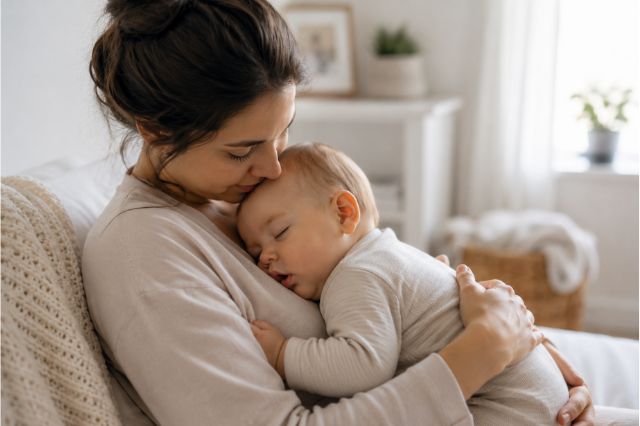
- Place your baby over your shoulder as if for burping. Excess air can escape. Gentle tapping on the back can provide support.
- Hold your baby up and blow very gently in their face. This can change the breathing rhythm and relax the diaphragm.
- Breastfeeding or drinking can also help, as the diaphragm often calms down during the process.
- A warm cherry stone pillow on the belly can have a soothing effect on stubborn hiccups.
By the way: Hiccups usually bother the parents more than the baby. Many babies sleep soundly despite hiccups. There is usually no cause for concern.
However, particularly stubborn hiccups can dampen the mood. An automatic baby hammock from swing2sleep provides relaxation even then. The gentle up and down motion has a calming effect and can help to resolve the hiccups.
When should you take a closer look at hiccups?
Hiccups alone are not a warning signal. A medical clarification can be useful if other abnormalities occur.
A conversation with the pediatrician is advisable if:
- the hiccups occur very frequently and persist over a long period of time,
- your baby seems very restless or cries a lot,
- they regularly spit up large amounts of milk,
- or increasingly refuse to drink.
Usually, there is no serious cause behind it even then. However, a quick clarification can provide peace of mind and relieve you.
How do I get rid of baby hiccups?
Hiccups often disappear on their own and do not require treatment.
It can be helpful to hold your baby calmly and upright or to take a short drinking break.
As long as your baby seems relaxed, hiccups are harmless.
What is the best position for a baby with hiccups?
An upright or slightly elevated position is often comfortable for your baby.
Gently leaning against your chest or shoulder can also have a calming effect.
It is important that your baby feels securely held.
Why does my baby have so many hiccups?
A baby's diaphragm is still very sensitive.
Drinking quickly, swallowing air, or a full stomach can trigger hiccups.
Frequent hiccups are usually normal in infancy.
What are hiccups a sign of?
In babies, hiccups are usually a sign of a still immature nervous system.
They often occur after drinking or when tired.
As long as your baby remains calm and behaves normally, hiccups are harmless.