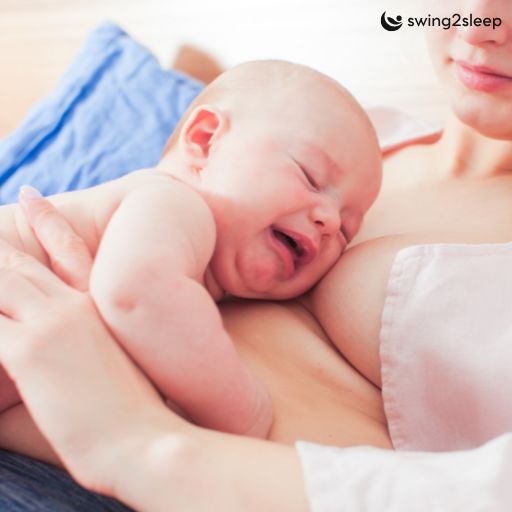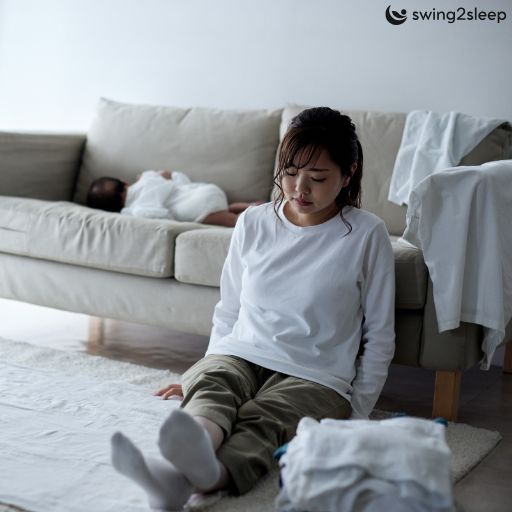



The first months of life are full of small wonders, surprises, and sleepless nights for both parents and baby. For most parents, this exciting time is certainly not only thrilling but, above all, exhausting. This is because babies cry a lot, especially at the beginning.
But what is normal, and at what point is a baby considered a so-called high-need baby? What is meant by regulation disorders, and what can parents do to calm their little sweetheart? We at swing2sleep have summarized all of this for you here in a compact format.
1. About high-need babies and regulation disorders
Is my baby a high-need baby?
Sleepless nights and frayed nerves are definitely a fixed part of being a parent in the first few months. However, as a rule, babies do not cry for more than an average of one to two hours per day (over the course of 24 hours). Usually, the crying subsides and becomes less frequent from the 3rd month of life onwards.
If, on the other hand, your baby cries excessively over a long period of time and cannot be calmed, or only with great difficulty, by carrying, changing, offering the breast, or going for a walk, then it could be a high-need baby.

Possible signs of a high-need baby
If your baby is screaming at the top of their lungs and your nerves are shot, you're probably wondering: Is this still normal or do I have a high-need baby? Basically, the following points indicate a high-need baby:
- Excessive crying from the 2nd week of life
- Intensity continues to increase from the 6th week of life.
- At the beginning of the 4th month, the crying usually becomes less.
How many babies suffer from regulation disorders?
16-29% of all infants are considered high-need babies in the first three months of life. Approx. 8% cry beyond the 3rd month.
Experts have developed the so-called rule of three, which you can use to check if your baby is crying excessively. It is as follows:
Your baby cries for 3 hours a day. Specifically, on at least 3 days of the week. This behavior lasts for more than 3 weeks.
Ultimately, only an expert, such as your pediatrician or midwife, can diagnose with certainty whether you have a high-need baby. However, the rule of three is definitely a good indicator.
In any case, seek help as soon as the situation becomes too stressful and you feel helpless or even desperate. You can find more on the subject and a detailed list of symptoms in our article "Infant is crying. Is my child a high-need baby? What is a high-need baby?".
Regulation disorders
In connection with excessive crying in infancy, experts speak of so-called regulation disorders as the cause.
High-need babies react very strongly to any stimuli and find it difficult to relax. Their crying is therefore a response to sensory overload, being overwhelmed, and difficulties in regulating their own behavior. High-need babies first have to learn how to cope with the many impressions in their environment and the world itself.
We have summarized exactly which signs indicate a regulation disorder for you in our article "Regulation disorders in babies".

2. Causes of high-need babies: What is behind excessive crying?
What is the truth about three-month colic?
In the past, things seemed clear: The baby is crying excessively? It must be three-month colic, i.e., severe flatulence and abdominal pain. However, it is now known that the causes for a high-need baby can be diverse and not everything can be traced back to flatulence and digestive problems. However, it is quite possible that your baby is suffering from colic.
You can recognize these by the following characteristics:
- Hard, bloated belly, legs often pulled up to the stomach.
- Heavy crying that lasts for around 3 hours per day.
Experts point out, however, that high-need babies usually cry in the early evening hours, which in a way speaks against colic. This is because colic does not only occur in the evening and at night, but can torment your baby at any time of the day.
However, if you suspect that your baby is suffering from severe flatulence and digestive problems, then definitely clarify this with a doctor.
If you would like to learn more, our article on three-month colic provides a good overview - including numerous tips on how you can prevent and avoid flatulence and intestinal problems in your baby.
Sensory overload: When it becomes too much for baby
Nowadays, it is known that sensory overload is often the main cause of high-need babies. No wonder, because when your little one is catapulted into our world after nine months protected in the safety of the womb, impressions rain down on the little one: noises, colors, people, voices - all of this can be quite overwhelming for your newborn.
As already mentioned, excessive crying usually occurs in the evening after your little one has experienced a lot throughout the day. That's why it's important that you first get your newborn used to the new world and the many impressions.
Peace and security is the motto, so try to create low-stimulus retreat options as much as possible. You can also find more interesting facts and tips in our article "Sensory overload in babies".
KiSS Syndrome: A controversial misalignment
Another possible cause of excessive crying could be Kinematic Imbalance due to Suboccipital Strain, also known as KiSS syndrome. With this misalignment, the child's body is not completely symmetrical, which blocks the cervical joints and the spine.
But: Evidence of whether KiSS syndrome is present is difficult to provide. And in fact, it is not recognized as a disease by conventional medicine. Many medical professionals doubt that the disorder actually exists.
You can find out which causes can be behind the misalignment and which signs could indicate the condition in our blog post about KiSS syndrome.

3. Calming a high-need baby: How to succeed
4 tips on how you can calm your high-need baby
The biggest challenge is certainly calming your high-need baby. Our founders know the problem all too well, because they brought swing2sleep to life for exactly this reason: To provide relief to other affected parents with motorized automatic baby hammocks.
But besides that, there are other tips you can follow, namely:
- Trust your intuition: Take your time and listen to yourself to find out what your baby wants to tell you with its crying and body language.
- Ensure a consistent rhythm: It is completely normal for your newborn to cry a lot and not yet have a regulated daily routine. It has to learn this first. As a mom or dad, you can help by bringing a certain structure, i.e. a rhythm, into your everyday life. Base this on your baby's sleep, wake, and rest times.
- Create rituals: In addition to the rhythm, rituals help to calm your baby. In addition to bedtime rituals, this also includes, for example, bathing and the subsequent baby massage. Think of rituals yourself that you can integrate well into everyday life and that give your baby a sense of security.
- Keep a crying diary: In this, you can record exactly when your newborn's crying fits occur. It's best to also write down what finally managed to calm the little one. This allows you to recognize certain crying patterns and interpret them better.
In addition, there are numerous other things you can do, which we have summarized for you in our article 28 calming tips for high-need babies.
Professional help needed?
However, if the crying simply doesn't get less or better, you should definitely seek professional help. We recommend visiting a crying clinic.
They specialize in high-need babies and can help you and your partner with a lot of empathy. You can find out exactly how the whole process works in our post What happens in a crying clinic?
The most important thing, however, is that you and your partner realize that you are not alone. A high-need baby pushes you to the absolute limits of your resilience and can cost you your last nerve. But there are many support services that you can take advantage of.
By the way, parents can also rent our swing2sleep automatic baby hammocks. Simply visit our rental configurator and put together your automatic baby hammock set for your needs. No obligation to buy and only for as long as you actually need the automatic baby hammock.
Would you like to learn more about the topic? Then be sure to visit our High-need baby blog, with many exciting articles, experience reports, and encouraging tips for affected parents. If you have any questions, you can also contact us at any time. We are happy to help you and advise you on our automatic baby hammocks.