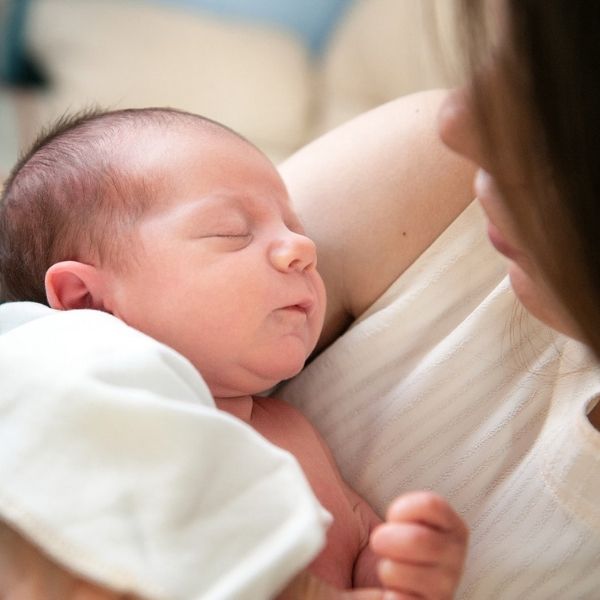


It is actually quite normal for mothers to experience the so-called baby blues shortly after giving birth. However, that doesn't change the fact that this time can be quite exhausting. The mother is exhausted, tired, and suffers from mood swings. For many women, it even hits like a bolt from the blue: first they are the happiest person in the world, and suddenly everything is different. Their mood is at rock bottom and their emotions are going crazy. Why does this happen? And what is the best way for you or your partner to deal with it?
Baby blues – what is it?
Baby blues is known in medical terms as "postpartum blues". It is a temporary low mood that occurs primarily in the first three to five days after birth. Those affected feel exhausted, react oversensitively and often burst into tears completely without reason. Understandably, these days are often referred to colloquially as the weepy days. After all, 8 out of 10 mothers notice this phenomenon in themselves.
What are the causes?
It is actually obvious: hormones are to blame for the baby blues. No wonder, because immediately after pregnancy, hormone levels drop sharply. It is hardly surprising that things get a bit mixed up. This hormonal change is much more significant than, for example, the one in the days before a period, which for many women is also a time of moodiness, depressive moods, and irritability.
Estrogen and progesterone levels plummet after birth, which causes mood swings and feelings of dejection.
In addition, many mothers are literally overwhelmed by the force of the emerging emotions: The awareness of the new task and the new responsibility can be frightening and intimidating. Even the deepest feelings of happiness can often change nothing about this.
Are there factors that influence the baby blues?
Not really. The location and type of birth seem to be secondary, and marital status or psychosocial influences also play no role. However, it was found that baby blues occur more frequently when the birth proceeds very differently than the mother had wished.
What are the symptoms of baby blues?
The woman is generally sensitive, irritable and bursts quickly into tears. Everything is too much for her, she cannot concentrate and worries excessively about the baby and the future. This is sometimes accompanied by sleep disorders, loss of appetite and at times even slight
aggressiveness.
When does the baby blues go away again?
Usually, the symptoms subside after a few days. So it pays to be a little patient. And for everyone who is in close contact with the mother – especially for the fathers –, it now means: keep calm.
What is the best way to handle it? An appeal to fathers
The baby blues is not an illness, which is why it usually does not need to be treated. As a rule, it goes away all by itself again. It is important that the mother has a person during this time she can talk to and who supports her in caring for the newborn. In the ideal case, this is the father, otherwise another person will of course do as well.
It is best if the mother is with her baby as much as possible during this time, because only then can the development of a close bond succeed. In addition, close relatives should show a lot of understanding for her during this time. She needs all the help she can get right now. Because she is out of action for a while, all the tasks she was able to perform until recently must be handled by others for a while. The mother must be there entirely for the baby. Housework, cooking, and everything else must not be neglected, however. Furthermore, friends and relatives should reduce visits to a minimum during this time. If the new mother allows it, gentle massages and tender touches can help bring her mood back into balance. Most importantly, however, is having an open ear for her worries and needs and giving her plenty of time to rest.
What if it doesn't go away?
In individual cases, it can happen that the symptoms have still not subsided after a few days. This could indicate the onset of postpartum depression, which in the worst case can escalate into postnatal psychosis. If the baby blues last longer than four weeks or if signs of depression are added, you should definitely consult a doctor.
The difference between baby blues and postpartum depression
While the baby blues occur in up to 80% of all mothers, only about 15% of all mothers develop postpartum depression. In the worst cases, affected mothers feel no love for their baby, suffer from the fact that life is dictated by others, and are crushed by the feeling of duty and responsibility. The causes of postpartum depression are diverse and cannot only be traced back to hormones. Often, particularly perfectionist women are affected, as well as women who have already previously suffered from depressive moods.
If there is a suspicion that the mother is suffering from postnatal depression, contact should be made as soon as possible with a doctor or a trusted midwife. Subsequent therapy can then take place on an outpatient or inpatient basis, depending on the severity. Timely action is important, because after all, an exciting life with a baby awaits the mother, and the newborn is dependent on the mom. Depression can be very hindering and a great burden for everyone involved. However, they are generally well-treatable, provided they are recognized and treated in time.
Mom has the blues, but the baby swings – with a swing2sleep
- The tightness
- The constant swinging movements
- The rounded back