

Shortly after birth, new parents usually have many questions about infant care: "How often can I bathe my baby? What can I do if our newborn has a sore bottom? What do we really need for baby care and what can we ultimately do without?"
Infant care sure, but how and what?
With a newborn baby, it's not just regular diaper changes that are on the agenda; umbilical cord care, bathing, and cutting fingernails and toenails are also important components of baby care.
Optimal umbilical cord care: Can we only bathe our baby once the umbilical cord stump has fallen off?
No, you don't have to wait that long. According to the latest recommendations for baby care, there is no increased risk of infection at all. Newborns can be bathed even before the umbilical cord stump has fallen off and the navel has completely healed. However, it is still advisable to wait until the so-called vernix caseosa has completely disappeared, because it contains extremely valuable substances for your newborn's skin.
Note: After birth, the umbilical cord stump dries up and usually falls off by itself after about 5 to 10 days. When changing diapers, however, you should make sure that the navel is not covered by the diaper, as the edge often rubs against the navel, which can cause inflammation. Please also make sure that the umbilical cord remnant is always nice and dry (e.g. dry the belly well after bathing), and avoid using creams or powders in this area if possible.
Bathing – less is more: How long and how often should we actually bathe our baby?
Your baby's skin is only about one-fifth as thick as an adult's skin and is therefore very sensitive. Therefore, it is perfectly sufficient to bathe your infant only once a week for a maximum of 10 minutes. Toddlers over one year old can stay in the water longer. However, if your baby loves the warm water and does not tend to have dry skin, there is nothing to stop you from letting your little one splash around more often. A sink, a special baby bathtub, or even a bucket are excellent for this. Note, however, that your child's body is only able to regulate its own temperature from around the second year of life. Therefore, a cozy warm temperature of approx. 24 °C should prevail in the bathroom; the optimal bath temperature is approx. 37 °C.
Note: Please never set the bath water too warm or even hot. It is best to use a bath thermometer with which you can set exactly the right temperature for your baby and check it continuously. Your baby's delicate and sensitive skin is prone to scalding even at lower temperatures.
Bath additives and shampoo: Do we need these products for infant care?
Your baby does not need any bath additives. Soap and some bubble bath additives tend to dry out your baby's skin rather than care for it. For babies who tend to have extremely dry skin, however, it is advisable to just add a little breast milk or two to three drops of olive oil to the water. Special bath oils for infants are also suitable. For your baby's fine hair, you don't actually need shampoo yet. The head should simply be carefully washed and rinsed with the bath water. Through gentle rubbing and rinsing, it becomes just as cared for and clean. Only when the baby's hair becomes thicker can a mild baby shampoo be used every now and then.
Note: After bathing, it is particularly important that you dry your baby well and, above all, pay attention to the small hidden skin folds (e.g. on the neck, armpits, and in the groin). Skin flakes often collect there and must be wiped off regularly so that skin inflammation does not occur in these areas.
Successful baby massage: Are there things we should keep in mind?
Baby massage is great as an every evening bedtime ritual – just like an automatic baby hammock from swing2sleep! Freshly bathed and extensively massaged, your baby will love being pleasantly rocked for 20 minutes before going to bed. It will relax well and quickly come to rest.
The massage strengthens the child's body awareness and has a positive influence on the parent-child bond. Use a special baby oil for this, because it simultaneously cares for the skin and protects it from drying out.
Note: Less is more here too. You should not massage for too long or too intensely. So please not until your baby's skin turns red or becomes very warm.
Tips for diapering: What can we do if the bottom is sore or red?
In the beginning, the topic of "diapering" makes many new parents feel insecure. The question often arises as to which diapers are better suited. Should disposable diapers be used and, if so, which ones? Or are cloth diapers better after all? And what care does the delicate baby bottom need anyway?
Don't worry: diapering your baby will very quickly become second nature to you. Which diaper you use for this depends entirely on you and your preferences. When cleaning your newborn's diaper area, it is recommended to use lukewarm water instead of wet wipes at the beginning. Wet wipes may be extremely practical, but they can potentially irritate sensitive infant skin. For girls, make sure to wash or wipe from front to back in the genital area so that no germs from the anus get into the vagina. For boys, you should not yet pull back the foreskin when washing. You can hold the penis very carefully downwards when closing the diaper so that the pee stays in the diaper.
If the bottom is bright red and sore, your baby is probably sensitive, and the digestion as well as the sensitive skin on the bottom are reacting to certain foods or spices. Teething babies also often struggle with a sore bottom. Of course, urine and stool also further irritate the sensitive and reddened areas. In such a case, you should change your baby's diaper more often and clean the bottom with lukewarm water. If possible, let your little one kick freely without a diaper in a heated room, as the air ensures better and faster wound healing. Additionally, you can apply a little calendula or zinc ointment to the sore spots to further support the healing process. A few drops of breast milk on the reddened area are also said to work wonders.
Fingernails and toenails: How do we best cut our baby's fingernails and toenails?
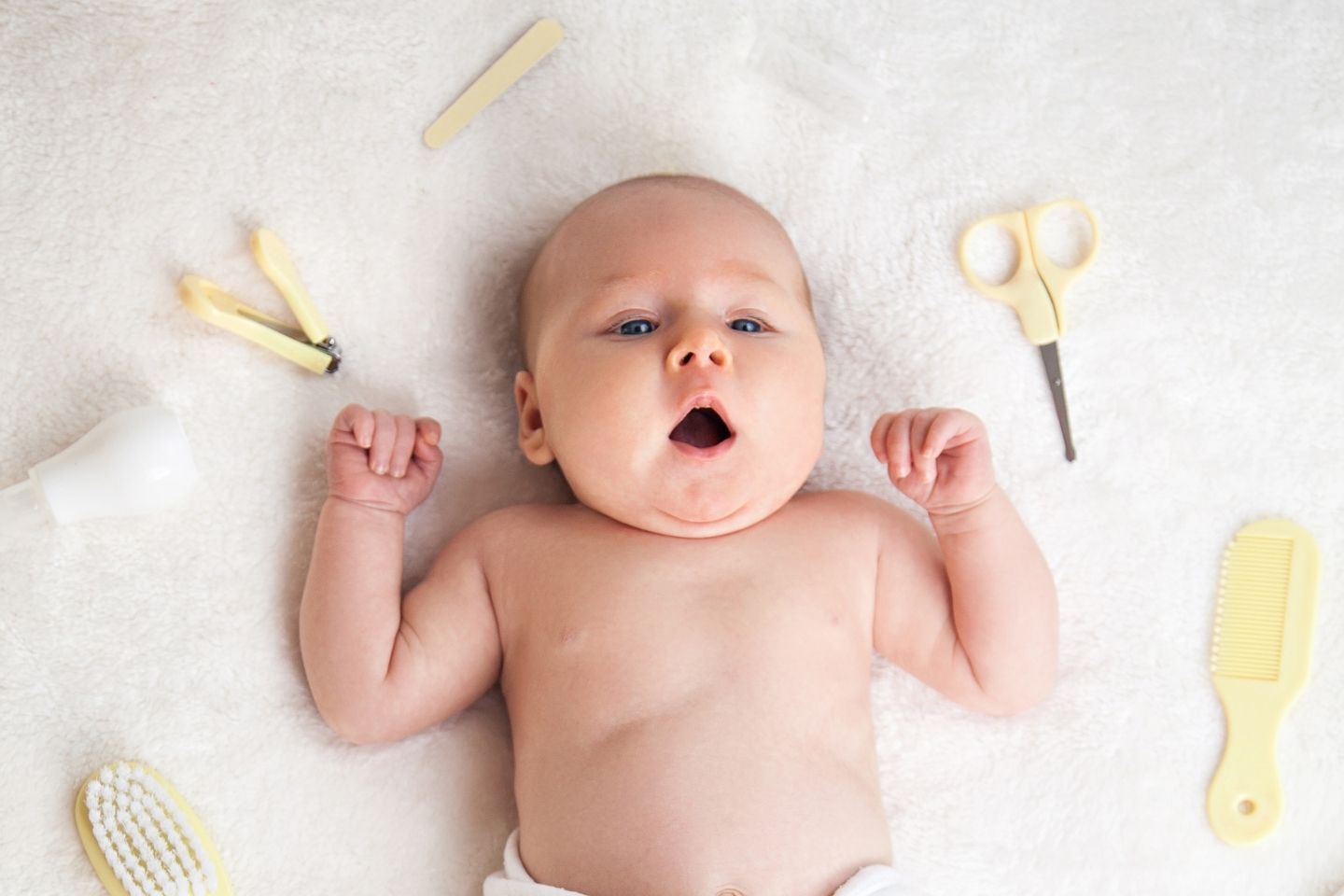
In the first period after your baby's birth, you should avoid cutting the nails for the time being. They are usually still very soft, and it is perfectly sufficient if you simply carefully pluck off the protruding and possibly sharp-edged edges. At about 6 weeks, you can then start to carefully cut the fingernails and toenails. From then on, it can certainly happen that your baby injures itself with the sharp nails. Therefore, it is best to get special baby nail scissors from the drugstore. These scissors are particularly flattened at the tip. Tip: Only cut your darling's nails when they have fallen asleep and are dreaming peacefully. Hold the small hand with a secure grip at the front of the fingers and press the fingertip down slightly. This way you can get to the nails much better with the scissors.
Cleaning ears: How can we care for the ears?
Here too: less is more! Ears actually have their own self-cleaning function. The earwax comes out of the ear all by itself over time and then simply needs to be wiped out of the auricle with a cloth. Cotton swabs are unsuitable and even rather dangerous because babies often tend to make jerky movements. The swab can be pushed deep into the ear and possibly injure the eardrum. In addition, it very often happens that the Q-tip only pushes the earwax deeper into the ear canal. This eventually forms a real plug that completely blocks the ear canal and must be flushed out by the pediatrician.
The right clothing: Which outfit for our baby?
By reaching into the back of your baby's neck, you can easily check whether your baby is too warm or too cold and adjust their clothing accordingly. If the skin feels warm and sweaty there, you should take something off to avoid heat accumulation. If, on the other hand, it is cold, your child is most likely freezing.
Sandman: Why does my baby have crusty eyes after sleeping?
In babies, it can happen that the tear duct has not yet opened after birth. In addition, newborns often still produce little tear fluid. To remove the sleep or crust from the eye, it is best to use a cotton pad or roll cotton wool between your thumb and index finger into a stem. You then dip the pad or stem into boiled but cool water and wipe the deposits from the eye. Please always wipe from the outside in (i.e. towards the nose).